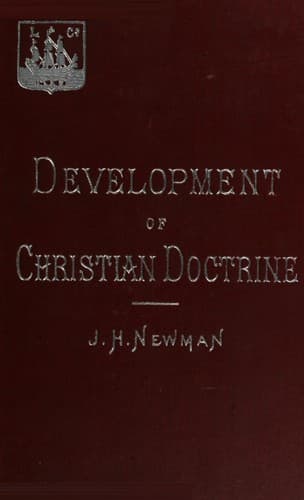
An Essay on the Development of Christian DoctrineNewman, John Henry
Religion
An Essay on the Development of Christian Doctrine
Newman, John Henry
Catholic Church -- Doctrines; Dogma, Development of
It was an argument for educated and simple. When St. Ambrose would
convert the cultivated reason of Augustine, he bade him study the book
of Isaiah, who is the prophet, as of the Messiah, so of the calling of
the Gentiles and of the Imperial power of the Church. And when St. Cyril
would give a rule to his crowd of Catechumens, "If ever thou art
sojourning in any city," he says, "inquire not simply where the Lord's
house is, (for the sects of the profane also make an attempt to call
their own dens houses of the Lord,) nor merely where the Church is, but
where is the Catholic Church. For this is the peculiar name of this Holy
Body, the Mother of us all, which is the Spouse of our Lord Jesus
Christ."[256:1] "In the Catholic Church," says St. Augustine to the
Manichees, "not to speak of that most pure wisdom, to the knowledge of
which few spiritual men attain in this life so as to know it even in its
least measure,--as men, indeed, yet, without any doubt,--(for the
multitude of Christians are safest, not in understanding with quickness,
but in believing with simplicity,) not to speak of this wisdom, which ye
do not believe to be in the Catholic Church, there are many other
considerations which most sufficiently hold me in her bosom. I am held
by the consent of people and nations; by that authority which began in
miracles, was nourished in hope, was increased by charity, and made
steadfast by age; by that succession of priests from the chair of the
Apostle Peter, to whose feeding the Lord after His resurrection
commended His sheep, even to the present episcopate; lastly, by the very
title of Catholic, which, not without cause, hath this Church alone,
amid so many heresies, obtained in such sort, that, whereas all
heretics wish to be called Catholics, nevertheless to any stranger, who
asked where to find the 'Catholic' Church, none of them would dare to
point to his own basilica or home. These dearest bonds, then, of the
Christian Name, so many and such, rightly hold a man in belief in the
Catholic Church, even though, by reason of the slowness of our
understanding or our deserts, truth doth not yet show herself in her
clearest tokens. But among you, who have none of these reasons to invite
and detain me, I hear but the loud sound of a promise of the truth;
which truth, verily, if it be so manifestly displayed among you that
there can be no mistake about it, is to be preferred to all those things
by which I am held in the Catholic Church; but if it is promised alone,
and not exhibited, no one shall move me from that faith which by so many
and great ties binds my mind to the Christian religion."[257:1] When
Adimantius asked his Marcionite opponent, how he was a Christian who did
not even bear that name, but was called from Marcion, he retorts, "And
you are called from the Catholic Church, therefore ye are not Christians
either;" Adimantius answers, "Did we profess man's name, you would have
Public-domain text, read in full here on John Shaqi.
Reviews
Reviews
No reviews yet
Be the first to share your thoughts on this work.
Elsewhere in the archive
Join the Discussion
Join the discussion
Sign in to leave a comment or review.
Sign InorCreate an account