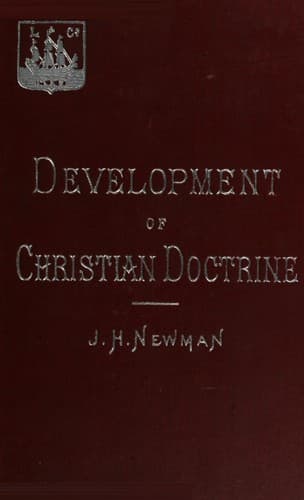
An Essay on the Development of Christian DoctrineNewman, John Henry
Religion
An Essay on the Development of Christian Doctrine
Newman, John Henry
Catholic Church -- Doctrines; Dogma, Development of
It cannot be supposed that these northern warriors had attained to any
high degree of mental cultivation; but they understood their own
religion enough to hate the Catholics, and their bishops were learned
enough to hold disputations for its propagation. They professed to stand
upon the faith of Ariminum, administering Baptism under an altered form
of words, and re-baptizing Catholics whom they gained over to their
sect. It must be added that, whatever was their cruelty or tyranny, both
Goths and Vandals were a moral people, and put to shame the Catholics
whom they dispossessed. "What can the prerogative of a religious name
profit us," says Salvian, "that we call ourselves Catholic, boast of
being the faithful, taunt Goths and Vandals with the reproach of an
heretical appellation, while we live in heretical wickedness?"[276:1]
The barbarians were chaste, temperate, just, and devout; the Visigoth
Theodoric repaired every morning with his domestic officers to his
chapel, where service was performed by the Arian priests; and one
singular instance is on record of the defeat of a Visigoth force by the
Imperial troops on a Sunday, when instead of preparing for battle they
were engaged in the religious services of the day.[276:2] Many of their
princes were men of great ability, as the two Theodorics, Euric and
Leovigild.
3.
Successful warriors, animated by a fanatical spirit of religion, were
not likely to be content with a mere profession of their own creed; they
proceeded to place their own priests in the religious establishments
which they found, and to direct a bitter persecution against the
vanquished Catholics. The savage cruelties of the Vandal Hunneric in
Africa have often been enlarged upon; Spain was the scene of repeated
persecutions; Sicily, too, had its Martyrs. Compared with these
enormities, it was but a little thing to rob the Catholics of their
churches, and the shrines of their treasures. Lands, immunities, and
jurisdictions, which had been given by the Emperors to the African
Church, were made over to the clergy of its conquerors; and by the time
of Belisarius, the Catholic Bishops had been reduced to less than a
third of their original number. In Spain, as in Africa, bishops were
driven from their sees, churches were destroyed, cemeteries profaned,
martyries rifled. When it was possible, the Catholics concealed the
relics in caves, keeping up a perpetual memory of these provisional
hiding-places.[277:1] Repeated spoliations were exercised upon the
property of the Church. Leovigild applied[277:2] its treasures partly to
increasing the splendour of his throne, partly to national works. At
other times, the Arian clergy themselves must have been the recipients
of the plunder: for when Childebert the Frank had been brought into
Spain by the cruelties exercised against the Catholic Queen of the
Goths, who was his sister, he carried away with him from the Arian
churches, as St. Gregory of Tours informs us, sixty chalices, fifteen
Public-domain text, read in full here on John Shaqi.
Reviews
Reviews
No reviews yet
Be the first to share your thoughts on this work.
Elsewhere in the archive
Join the Discussion
Join the discussion
Sign in to leave a comment or review.
Sign InorCreate an account