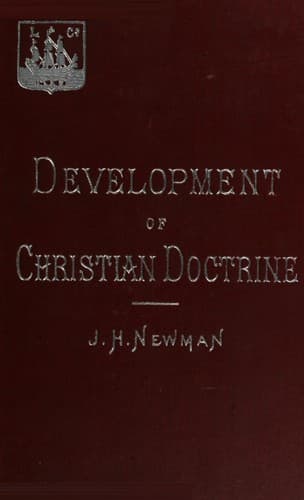
An Essay on the Development of Christian DoctrineNewman, John Henry
Religion
An Essay on the Development of Christian Doctrine
Newman, John Henry
Catholic Church -- Doctrines; Dogma, Development of
patens, twenty cases in which the gospels were kept, all of pure gold
and ornamented with jewels.[277:3]
4.
In France, and especially in Italy, the rule of the heretical power was
much less oppressive; Theodoric, the Ostrogoth, reigned from the Alps to
Sicily, and till the close of a long reign he gave an ample toleration
to his Catholic subjects. He respected their property, suffered their
churches and sacred places to remain in their hands, and had about his
court some of their eminent Bishops, since known as Saints, St. Cæsarius
of Arles, and St. Epiphanius of Pavia. Still he brought into the country
a new population, devoted to Arianism, or, as we now speak, a new
Church. "His march," says Gibbon,[277:4] "must be considered as the
emigration of an entire people; the wives and children of the Goths,
their aged parents, and most precious effects, were carefully
transported; and some idea may be formed of the heavy luggage that now
followed the camp by the loss of two thousand waggons, which had been
sustained in a single action in the war of Epirus." To his soldiers he
assigned a third of the soil of Italy, and the barbarian families
settled down with their slaves and cattle. The original number of the
Vandal conquerors of Africa had only been fifty thousand men, but the
military colonists of Italy soon amounted to the number of two hundred
thousand; which, according to the calculation adopted by the same author
elsewhere, involves a population of a million. The least that could be
expected was, that an Arian ascendency established through the extent of
Italy would provide for the sufficient celebration of the Arian worship,
and we hear of the Arians having a Church even in Rome.[278:1] The rule
of the Lombards in the north of Italy succeeded to that of the
Goths,--Arians, like their predecessors, without their toleration. The
clergy whom they brought with them seem to have claimed their share in
the possession of the Catholic churches;[278:2] and though the Court was
converted at the end of thirty years, many cities in Italy were for some
time afterwards troubled by the presence of heretical bishops.[278:3]
The rule of Arianism in France lasted for eighty years; in Spain for a
hundred and eighty; in Africa for a hundred; for about a hundred in
Italy. These periods were not contemporaneous; but extend altogether
from the beginning of the fifth to the end of the sixth century.
5.
Public-domain text, read in full here on John Shaqi.
Reviews
Reviews
No reviews yet
Be the first to share your thoughts on this work.
Elsewhere in the archive
Join the Discussion
Join the discussion
Sign in to leave a comment or review.
Sign InorCreate an account