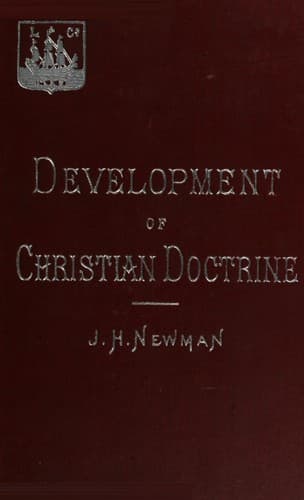
An Essay on the Development of Christian DoctrineNewman, John Henry
Religion
An Essay on the Development of Christian Doctrine
Newman, John Henry
Catholic Church -- Doctrines; Dogma, Development of
It will be anticipated that the duration of this ascendency of error
had not the faintest tendency to deprive the ancient Church of the West
of the title of Catholic; and it is needless to produce evidence of a
fact which is on the very face of the history. The Arians seem never to
have claimed the Catholic name. It is more remarkable that the Catholics
during this period were denoted by the additional title of "Romans." Of
this there are many proofs in the histories of St. Gregory of Tours,
Victor of Vite, and the Spanish Councils. Thus, St. Gregory speaks of
Theodegisilus, a king of Portugal, expressing his incredulity at a
miracle, by saying, "It is the temper of the Romans, (for," interposes
the author, "they call men of our religion Romans,) and not the power of
God."[279:1] "Heresy is everywhere an enemy to Catholics," says the same
St. Gregory in a subsequent place, and he proceeds to illustrate it by
the story of a "Catholic woman," who had a heretic husband, to whom, he
says, came "a presbyter of our religion very Catholic;" and whom the
husband matched at table with his own Arian presbyter, "that there might
be the priests of each religion" in their house at once. When they were
eating, the husband said to the Arian, "Let us have some sport with this
presbyter of the Romans."[279:2] The Arian Count Gomachar, seized on the
lands of the Church of Agde in France, and was attacked with a fever; on
his recovery, at the prayers of the Bishop, he repented of having asked
for them, observing, "What will these Romans say now? that my fever came
of taking their land."[279:3] When the Vandal Theodoric would have
killed the Catholic Armogastes, after failing to torture him into
heresy, his presbyter dissuaded him, "lest the Romans should begin to
call him a Martyr."[279:4]
6.
This appellation had two meanings; one, which will readily suggest
itself, is its use in contrast to the word "barbarian," as denoting the
faith of the Empire, as "Greek" occurs in St. Paul's Epistles. In this
sense it would more naturally be used by the Romans themselves than by
others. Thus Salvian says, that "nearly all the Romans are greater
sinners than the barbarians;"[280:1] and he speaks of "Roman heretics,
of which there is an innumerable multitude,"[280:2] meaning heretics
within the Empire. And so St. Gregory the Great complains, that he "had
become Bishop of the Lombards rather than of the Romans."[280:3] And
Evagrius, speaking even of the East, contrasts "Romans and
barbarians"[280:4] in his account of St. Simeon; and at a later date,
and even to this day, Thrace and portions of Dacia and of Asia Minor
derive their name from Rome. In like manner, we find Syrian writers
sometimes speaking of the religion of the Romans, sometimes of the
Greeks,[280:5] as synonymes.
7.
Public-domain text, read in full here on John Shaqi.
Reviews
Reviews
No reviews yet
Be the first to share your thoughts on this work.
Elsewhere in the archive
Join the Discussion
Join the discussion
Sign in to leave a comment or review.
Sign InorCreate an account