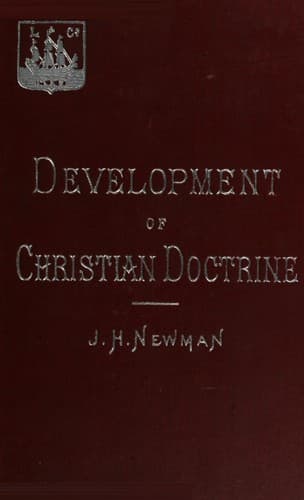
An Essay on the Development of Christian DoctrineNewman, John Henry
Religion
An Essay on the Development of Christian Doctrine
Newman, John Henry
Catholic Church -- Doctrines; Dogma, Development of
[228:2] Min. c. 11. Lact. v. 1, 2, vid. Arnob. ii. 8, &c.
[228:3] Origen, contr. Cels. i. 9, iii. 44, 50, vi. 44.
[229:1] Prudent. in hon. Fruct. 37.
[229:2] Evan. Dem. iii. 3, 4.
[229:3] Mort. Peregr. 13.
[229:4] c. 108.
[229:5] i. e. Philop. 16.
[229:6] De Mort. Pereg. ibid.
[229:7] Ruin. Mart. pp. 100, 594, &c.
[230:1] Prud. in hon. Rom. vv. 404, 868.
[230:2] We have specimens of _carmina_ ascribed to Christians in the
Philopatris.
[230:3] Goth. in Cod. Th. t. 5, p. 120, ed. 1665. Again, "Qui malefici
vulgi consuetudine nuncupantur." Leg. 6. So Lactantius, "Magi et ii quos
verè maleficos vulgus appellat." Inst. ii. 17. "Quos et maleficos vulgus
appellat." August. Civ. Dei, x. 19. "Quos vulgus mathematicos vocat."
Hieron. in Dan. c. ii. Vid. Gothof. in loc. Other laws speak of those
who were "maleficiorum labe polluti," and of the "maleficiorum scabies."
[230:4] Tertullian too mentions the charge of "hostes principum
Romanorum, populi, generis humani, Deorum, Imperatorum, legum, morum,
naturæ totius inimici." Apol. 2, 35, 38, ad. Scap. 4, ad. Nat. i. 17.
[231:1] Evid. part ii. ch. 4.
[232:1] Heathen Test. 9.
[233:1] Gothof. in Cod. Th. t. 5, p. 121.
[233:2] Cic. pro Cluent. 61. Gieseler transl. vol. i. p. 21, note 5.
Acad. Inscr. t. 34, hist. p. 110.
[234:1] De Harusp. Resp. 9.
[234:2] De Legg. ii. 8.
[234:3] Acad. Inscr. ibid.
[234:4] Neander, Eccl. Hist. tr. vol. i. p. 81.
[234:5] Muller, p. 21, 22, 30. Tertull. Ox. tr. p. 12, note _p_.
[235:1] Gibbon, Hist. ch. 16, note 14.
[235:2] Epit. Instit. 55.
[236:1] Gibbon, ibid. Origen admits and defends the violation of the
laws: οὐκ ἄλογον συνθήκας παρὰ τὰ νενομισμένα ποιεῖν, τὰς ὑπὲρ ἁληθείας. c. Cels. i. 1.
[237:1] Hist. p. 418.
[237:2] In hon. Rom. 62. In Act. S. Cypr. 4, Tert. Apol. 10, &c.
[238:1] Apol. i. 3, 39, Oxf. tr.
[241:1] Julian ap. Cyril, pp. 39, 194, 206, 335. Epp. pp. 305, 429, 438,
ed. Spanh.
[242:1] Niebuhr ascribes it to the beginning of the tenth.
[245:1] Sirm. Opp. ii. p. 225, ed. Ven.
[247:1] Proph. Office, p. 132 [Via Media, vol. i. p. 109].
[247:2] [Since the publication of this volume in 1845, a writer in a
Conservative periodical of great name has considered that no happier
designation could be bestowed upon us than that which heathen statesmen
gave to the first Christians, "enemies of the human race." What a
remarkable witness to our identity with the Church of St. Paul ("a
pestilent fellow, and a mover of sedition throughout the world"), of St.
Ignatius, St. Polycarp, and the other Martyrs! In this matter,
Conservative politicians join with Liberals, and with the movement
parties in Great Britain, France, Germany, and Italy, in their view of
our religion.
Public-domain text, read in full here on John Shaqi.
Reviews
Reviews
No reviews yet
Be the first to share your thoughts on this work.
Elsewhere in the archive
Join the Discussion
Join the discussion
Sign in to leave a comment or review.
Sign InorCreate an account