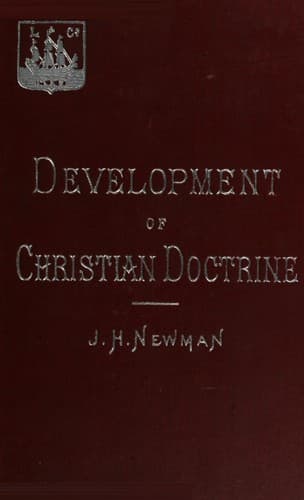
An Essay on the Development of Christian DoctrineNewman, John Henry
Religion
An Essay on the Development of Christian Doctrine
Newman, John Henry
Catholic Church -- Doctrines; Dogma, Development of
[322:1] [The above sketch has run to great length, yet it is only part
of what might be set down in evidence of the wonderful identity of type
which characterizes the Catholic Church from first to last. I have
confined myself for the most part to her political aspect; but a
parallel illustration might be drawn simply from her doctrinal, or from
her devotional. As to her devotional aspect, Cardinal Wiseman has shown
its identity in the fifth compared with the nineteenth century, in an
article of the _Dublin Review_, quoted in part in _Via Media_, vol. ii.
p. 378. Indeed it is confessed on all hands, as by Middleton, Gibbon,
&c., that from the time of Constantine to their own, the system and the
phenomena of worship in Christendom, from Moscow to Spain, and from
Ireland to Chili, is one and the same. I have myself paralleled Medieval
Europe with modern Belgium or Italy, in point of ethical character in
"Difficulties of Anglicans," vol. i. Lecture ix., referring the identity
to the operation of a principle, insisted on presently, the Supremacy of
Faith. And so again, as to the system of Catholic doctrine, the type of
the Religion remains the same, because it has developed according to the
"analogy of faith," as is observed in _Apol._, p. 196, "The idea of the
Blessed Virgin was, as it were, _magnified_ in the Church of Rome, as
time went on, but so were _all_ the Christian ideas, as that of the
Blessed Eucharist," &c.]
CHAPTER VII.
APPLICATION OF THE SECOND NOTE OF A TRUE DEVELOPMENT.
CONTINUITY OF PRINCIPLES.
It appears then that there has been a certain general type of
Christianity in every age, by which it is known at first sight,
differing from itself only as what is young differs from what is mature,
or as found in Europe or in America, so that it is named at once and
without hesitation, as forms of nature are recognized by experts in
physical science; or as some work of literature or art is assigned to
its right author by the critic, difficult as may be the analysis of that
specific impression by which he is enabled to do so. And it appears that
this type has remained entire from first to last, in spite of that
process of development which seems to be attributed by all parties, for
good or bad, to the doctrines, rites, and usages in which Christianity
consists; or, in other words, that the changes which have taken place in
Christianity have not been such as to destroy that type,--that is, that
they are not corruptions, because they are consistent with that type.
Here then, in the _preservation of type_, we have a first Note of the
fidelity of the existing developments of Christianity. Let us now
proceed to a second.
§ 1. _The Principles of Christianity._
Public-domain text, read in full here on John Shaqi.
Reviews
Reviews
No reviews yet
Be the first to share your thoughts on this work.
Elsewhere in the archive
Join the Discussion
Join the discussion
Sign in to leave a comment or review.
Sign InorCreate an account