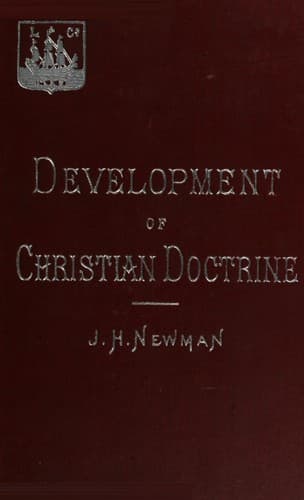
An Essay on the Development of Christian DoctrineNewman, John Henry
Religion
An Essay on the Development of Christian Doctrine
Newman, John Henry
Catholic Church -- Doctrines; Dogma, Development of
When developments in Christianity are spoken of, it is sometimes
supposed that they are deductions and diversions made at random,
according to accident or the caprice of individuals; whereas it is
because they have been conducted all along on definite and continuous
principles that the type of the Religion has remained from first to last
unalterable. What then are the principles under which the developments
have been made? I will enumerate some obvious ones.
2.
They must be many and positive, as well as obvious, if they are to be
effective; thus the Society of Friends seems in the course of years to
have changed its type in consequence of its scarcity of principles, a
fanatical spiritualism and an intense secularity, types simply contrary
to each other, being alike consistent with its main principle, "Forms of
worship are Antichristian." Christianity, on the other hand, has
principles so distinctive, numerous, various, and operative, as to be
unlike any other religious, ethical, or political system that the world
has ever seen, unlike, not only in character, but in persistence in that
character. I cannot attempt here to enumerate more than a few by way of
illustration.
3.
For the convenience of arrangement, I will consider the Incarnation the
central truth of the gospel, and the source whence we are to draw out
its principles. This great doctrine is unequivocally announced in
numberless passages of the New Testament, especially by St. John and St.
Paul; as is familiar to us all: "The Word was made flesh and dwelt among
us, full of grace and truth." "That which was from the beginning, which
we have heard, which we have seen with our eyes, which we have looked
upon, and our hands have handled, of the Word of life, that declare we
to you." "For ye know the grace of our Lord Jesus Christ, that, though
He was rich, yet for your sakes He became poor, that ye through His
poverty might be rich." "Not I, but Christ liveth in me, and the life
which I now live in the flesh, I live by the faith of the Son of God,
who loved me and gave Himself for me."
4.
In such passages as these we have
1. The principle of _dogma_, that is, supernatural truths irrevocably
committed to human language, imperfect because it is human, but
definitive and necessary because given from above.
2. The principle of _faith_, which is the correlative of dogma, being
the absolute acceptance of the divine Word with an internal assent, in
opposition to the informations, if such, of sight and reason.
3. Faith, being an act of the intellect, opens a way for inquiry,
comparison and inference, that is, for science in religion, in
subservience to itself; this is the principle of _theology_.
4. The doctrine of the Incarnation is the announcement of a divine gift
conveyed in a material and visible medium, it being thus that heaven and
earth are in the Incarnation united. That is, it establishes in the very
idea of Christianity the _sacramental_ principle as its characteristic.
Public-domain text, read in full here on John Shaqi.
Reviews
Reviews
No reviews yet
Be the first to share your thoughts on this work.
Elsewhere in the archive
Join the Discussion
Join the discussion
Sign in to leave a comment or review.
Sign InorCreate an account