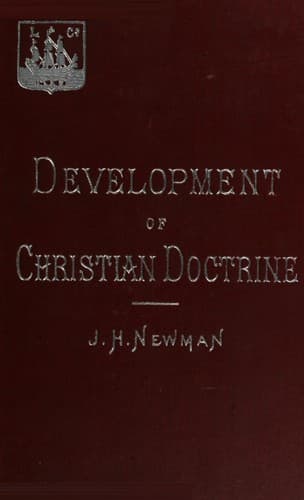
An Essay on the Development of Christian DoctrineNewman, John Henry
Religion
An Essay on the Development of Christian Doctrine
Newman, John Henry
Catholic Church -- Doctrines; Dogma, Development of
5. Another principle involved in the doctrine of the Incarnation, viewed
as taught or as dogmatic, is the necessary use of language, e. g. of the
text of Scripture, in a second or _mystical sense_. Words must be made
to express new ideas, and are invested with a sacramental office.
6. It is our Lord's intention in His Incarnation to make us what He is
Himself; this is the principle of _grace_, which is not only holy but
sanctifying.
7. It cannot elevate and change us without mortifying our lower
nature:--here is the principle of _asceticism_.
8. And, involved in this death of the natural man, is necessarily a
revelation of the _malignity of sin_, in corroboration of the
forebodings of conscience.
9. Also by the fact of an Incarnation we are taught that matter is an
essential part of us, and, as well as mind, is _capable of
sanctification_.
5.
Here are nine specimens of Christian principles out of the many[326:1]
which might be enumerated, and will any one say that they have not been
retained in vigorous action in the Church at all times amid whatever
development of doctrine Christianity has experienced, so as even to be
the very instruments of that development, and as patent, and as
operative, in the Latin and Greek Christianity of this day as they were
in the beginning?
This continuous identity of principles in ecclesiastical action has been
seen in part in treating of the Note of Unity of type, and will be seen
also in the Notes which follow; however, as some direct account of them,
in illustration, may be desirable, I will single out four as
specimens,--Faith, Theology, Scripture, and Dogma.
§ 2. _Supremacy of Faith._
This principle which, as we have already seen, was so great a jest to
Celsus and Julian, is of the following kind:--That belief in
Christianity is in itself better than unbelief; that faith, though an
intellectual action, is ethical in its origin; that it is safer to
believe; that we must begin with believing; that as for the reasons of
believing, they are for the most part implicit, and need be but slightly
recognized by the mind that is under their influence; that they consist
moreover rather of presumptions and ventures after the truth than of
accurate and complete proofs; and that probable arguments, under the
scrutiny and sanction of a prudent judgment, are sufficient for
conclusions which we even embrace as most certain, and turn to the most
important uses.
2.
Public-domain text, read in full here on John Shaqi.
Reviews
Reviews
No reviews yet
Be the first to share your thoughts on this work.
Elsewhere in the archive
Join the Discussion
Join the discussion
Sign in to leave a comment or review.
Sign InorCreate an account