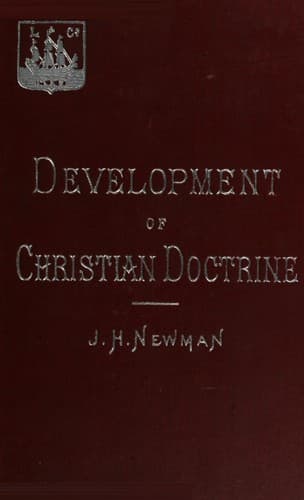
An Essay on the Development of Christian DoctrineNewman, John Henry
Religion
An Essay on the Development of Christian Doctrine
Newman, John Henry
Catholic Church -- Doctrines; Dogma, Development of
The first step in theology is investigation, an investigation arising
out of the lively interest and devout welcome which the matters
investigated claim of us; and, if Scripture teaches us the duty of
faith, it teaches quite as distinctly that loving inquisitiveness which
is the life of the _Schola_. It attributes that temper both to the
Blessed Virgin and to the Angels. The Angels are said to have "desired
to look into the mysteries of Revelation," and it is twice recorded of
Mary that she "kept these things and pondered them in her heart."
Moreover, her words to the Archangel, "How shall this be?" show that
there is a questioning in matters revealed to us compatible with the
fullest and most absolute faith. It has sometimes been said in defence
and commendation of heretics that "their misbelief at least showed that
they had thought upon the subject of religion;" this is an unseemly
paradox,--at the same time there certainly is the opposite extreme of a
readiness to receive any number of dogmas at a minute's warning, which,
when it is witnessed, fairly creates a suspicion that they are merely
professed with the tongue, not intelligently held. Our Lord gives no
countenance to such lightness of mind; He calls on His disciples to use
their reason, and to submit it. Nathanael's question "Can there any good
thing come out of Nazareth?" did not prevent our Lord's praise of him as
"an Israelite without guile." Nor did He blame Nicodemus, except for
want of theological knowledge, on his asking "How can these things be?"
Even towards St. Thomas He was gentle, as if towards one of those who
had "eyes too tremblingly awake to bear with dimness for His sake." In
like manner He praised the centurion when he argued himself into a
confidence of divine help and relief from the analogy of his own
profession; and left his captious enemies to prove for themselves from
the mission of the Baptist His own mission; and asked them "if David
called Him Lord, how was He his Son?" and, when His disciples wished to
have a particular matter taught them, chid them for their want of
"understanding." And these are but some out of the various instances
which He gives us of the same lesson.
3.
Reason has ever been awake and in exercise in the Church after Him from
the first. Scarcely were the Apostles withdrawn from the world, when the
Martyr Ignatius, in his way to the Roman Amphitheatre, wrote his
strikingly theological Epistles; he was followed by Irenæus, Hippolytus,
and Tertullian; thus we are brought to the age of Athanasius and his
contemporaries, and to Augustine. Then we pass on by Maximus and John
Damascene to the Middle age, when theology was made still more
scientific by the Schoolmen; nor has it become less so, by passing on
from St. Thomas to the great Jesuit writers Suarez and Vasquez, and then
to Lambertini.
§ 4. _Scripture and its Mystical Interpretation._
Public-domain text, read in full here on John Shaqi.
Reviews
Reviews
No reviews yet
Be the first to share your thoughts on this work.
Elsewhere in the archive
Join the Discussion
Join the discussion
Sign in to leave a comment or review.
Sign InorCreate an account