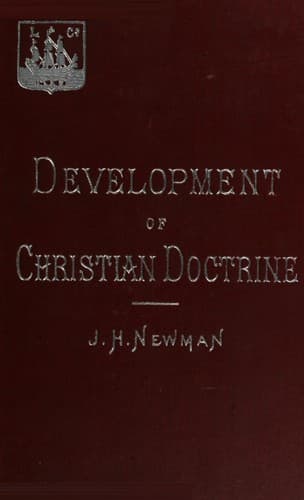
An Essay on the Development of Christian DoctrineNewman, John Henry
Religion
An Essay on the Development of Christian Doctrine
Newman, John Henry
Catholic Church -- Doctrines; Dogma, Development of
He presently adds concerning the allegorical sense: "If we absolutely
condemn these interpretations, then must we condemn a great part of
Antiquity, who are very much conversant in this kind of interpreting.
For the most partial for Antiquity cannot choose but see and confess
thus much, that for the literal sense, the interpreters of our own
times, because of their skill in the original languages, their care of
pressing the circumstances and coherence of the text, of comparing like
places of Scripture with like, have generally surpassed the best of the
ancients."[346:2]
The use of Scripture then, especially its spiritual or second sense, as
a medium of thought and deduction, is a characteristic principle of
doctrinal teaching in the Church.
§ 5. _Dogma._
1. That opinions in religion are not matters of indifference, but have a
definite bearing on the position of their holders in the Divine Sight,
is a principle on which the Evangelical Faith has from the first
developed, and on which that Faith has been the first to develope. I
suppose, it hardly had any exercise under the Law; the zeal and
obedience of the ancient people being mainly employed in the maintenance
of divine worship and the overthrow of idolatry, not in the action of
the intellect. Faith is in this, as in other respects, a characteristic
of the Gospel, except so far as it was anticipated, as its time drew
near. Elijah and the prophets down to Ezra resisted Baal or restored the
Temple Service; the Three Children refused to bow down before the golden
image; Daniel would turn his face towards Jerusalem; the Maccabees
spurned the Grecian paganism. On the other hand, the Greek Philosophers
were authoritative indeed in their teaching, enforced the "_Ipse
dixit_," and demanded the faith of their disciples; but they did not
commonly attach sanctity or reality to opinions, or view them in a
religious light. Our Saviour was the first to "bear witness to the
Truth," and to die for it, when "before Pontius Pilate he witnessed a
good confession." St. John and St. Paul, following his example, both
pronounce anathema on those who denied "the Truth" or "brought in
another Gospel." Tradition tells us that the Apostle of love seconded
his word with his deed, and on one occasion hastily quitted a bath
because an heresiarch of the day had entered it. St. Ignatius, his
contemporary, compares false teachers to raging dogs; and St. Polycarp,
his disciple, exercised the same seventy upon Marcion which St. John had
shown towards Cerinthus.
2.
Public-domain text, read in full here on John Shaqi.
Reviews
Reviews
No reviews yet
Be the first to share your thoughts on this work.
Elsewhere in the archive
Join the Discussion
Join the discussion
Sign in to leave a comment or review.
Sign InorCreate an account