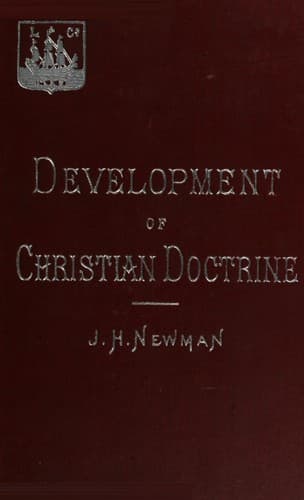
An Essay on the Development of Christian DoctrineNewman, John Henry
Religion
An Essay on the Development of Christian Doctrine
Newman, John Henry
Catholic Church -- Doctrines; Dogma, Development of
St. Irenæus after St. Polycarp exemplifies the same doctrine: "I saw
thee," he says to the heretic Florinus, "when I was yet a boy, in lower
Asia, with Polycarp, when thou wast living splendidly in the Imperial
Court, and trying to recommend thyself to him. I remember indeed what
then happened better than more recent occurrences, for the lessons of
boyhood grow with the mind and become one with it. Thus I can name the
place where blessed Polycarp sat and conversed, and his goings out and
comings in, and the fashion of his life, and the appearance of his
person, and his discourses to the people, and his familiarity with John,
which he used to tell of, and with the rest who had seen the Lord, and
how he used to repeat their words, and what it was that he had learned
about the Lord from them. . . . And in the sight of God, I can protest,
that, if that blessed and apostolical Elder had heard aught of this
doctrine, he had cried out and stopped his ears, saying after his wont,
'O Good God, for what times hast thou reserved me that I should endure
this?' and he had fled the place where he was sitting or standing when
he heard it." It seems to have been the duty of every individual
Christian from the first to witness in his place against all opinions
which were contrary to what he had received in his baptismal
catechizing, and to shun the society of those who maintained them. "So
religious," says Irenæus after giving his account of St. Polycarp, "were
the Apostles and their disciples, in not even conversing with those who
counterfeited the truth."[348:1]
3.
Such a principle, however, would but have broken up the Church the
sooner, resolving it into the individuals of which it was composed,
unless the Truth, to which they were to bear witness, had been a
something definite, and formal, and independent of themselves.
Christians were bound to defend and to transmit the faith which they had
received, and they received it from the rulers of the Church; and, on
the other hand, it was the duty of those rulers to watch over and define
this traditionary faith. It is unnecessary to go over ground which has
been traversed so often of late years. St. Irenæus brings the subject
before us in his description of St. Polycarp, part of which has already
been quoted; and to it we may limit ourselves. "Polycarp," he says when
writing against the Gnostics, "whom we have seen in our first youth,
ever taught those lessons which he learned from the Apostles, which the
Church also transmits, which alone are true. All the Churches of Asia
bear witness to them; and the successors of Polycarp down to this day,
who is a much more trustworthy and sure witness of truth than
Valentinus, Marcion, or their perverse companions. The same was in Rome
in the time of Anicetus, and converted many of the aforenamed heretics
to the Church of God, preaching that he had received from the Apostles
this one and only truth, which had been transmitted by the
Church."[349:1]
4.
Public-domain text, read in full here on John Shaqi.
Reviews
Reviews
No reviews yet
Be the first to share your thoughts on this work.
Elsewhere in the archive
Join the Discussion
Join the discussion
Sign in to leave a comment or review.
Sign InorCreate an account