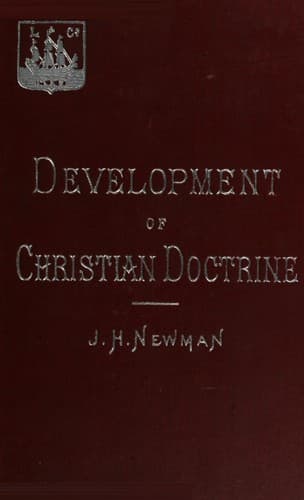
An Essay on the Development of Christian DoctrineNewman, John Henry
Religion
An Essay on the Development of Christian Doctrine
Newman, John Henry
Catholic Church -- Doctrines; Dogma, Development of
the dogmatic principle: they are not that principle themselves; they
presuppose the principle; they are summoned into action at the call of
the principle, and the principle might act even before they had their
legitimate place, and exercised a recognized power, in the movements of
the Christian body.
5.
The instance of Conscience, which has already served us in illustration,
may assist us here. What Conscience is in the history of an individual
mind, such was the dogmatic principle in the history of Christianity.
Both in the one case and the other, there is the gradual formation of a
directing power out of a principle. The natural voice of Conscience is
far more imperative in testifying and enforcing a rule of duty, than
successful in determining that duty in particular cases. It acts as a
messenger from above, and says that there is a right and a wrong, and
that the right must be followed; but it is variously, and therefore
erroneously, trained in the instance of various persons. It mistakes
error for truth; and yet we believe that on the whole, and even in those
cases where it is ill-instructed, if its voice be diligently obeyed, it
will gradually be cleared, simplified, and perfected, so that minds,
starting differently will, if honest, in course of time converge to one
and the same truth. I do not hereby imply that there is indistinctness
so great as this in the theology of the first centuries; but so far is
plain, that the early Church and Fathers exercised far more a ruler's
than a doctor's office: it was the age of Martyrs, of acting not of
thinking. Doctors succeeded Martyrs, as light and peace of conscience
follow upon obedience to it; yet, even before the Church had grown into
the full measure of its doctrines, it was rooted in its principles.
6.
So far, however, may be granted to M. Guizot, that even principles were
not so well understood and so carefully handled at first, as they were
afterwards. In the early period, we see traces of a conflict, as well as
of a variety, in theological elements, which were in course of
combination, but which required adjustment and management before they
could be used with precision as one. In a thousand instances of a minor
character, the statements of the early Fathers are but tokens of the
multiplicity of openings which the mind of the Church was making into
the treasure-house of Truth; real openings, but incomplete or irregular.
Nay, the doctrines even of the heretical bodies are indices and
anticipations of the mind of the Church. As the first step in settling a
question of doctrine is to raise and debate it, so heresies in every age
may be taken as the measure of the existing state of thought in the
Church, and of the movement of her theology; they determine in what way
the current is setting, and the rate at which it flows.
7.
Public-domain text, read in full here on John Shaqi.
Reviews
Reviews
No reviews yet
Be the first to share your thoughts on this work.
Elsewhere in the archive
Join the Discussion
Join the discussion
Sign in to leave a comment or review.
Sign InorCreate an account