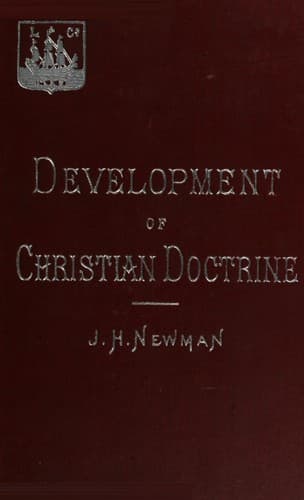
An Essay on the Development of Christian DoctrineNewman, John Henry
Religion
An Essay on the Development of Christian Doctrine
Newman, John Henry
Catholic Church -- Doctrines; Dogma, Development of
This was but another form of the spirit that made martyrs. Dogmatism was
in teaching, what confession was in act. Each was the same strong
principle of life in a different aspect, distinguishing the faith which
was displayed in it from the world's philosophies on the one side, and
the world's religions on the other. The heathen sects and the heresies
of Christian history were dissolved by the breath of opinion which made
them; paganism shuddered and died at the very sight of the sword of
persecution, which it had itself unsheathed. Intellect and force were
applied as tests both upon the divine and upon the human work; they
prevailed with the human, they did but become instruments of the Divine.
"No one," says St. Justin, "has so believed Socrates as to die for the
doctrine which he taught." "No one was ever found undergoing death for
faith in the sun."[359:1] Thus Christianity grew in its proportions,
gaining aliment and medicine from all that it came near, yet preserving
its original type, from its perception and its love of what had been
revealed once for all and was no private imagination.
4.
There are writers who refer to the first centuries of the Church as a
time when opinion was free, and the conscience exempt from the
obligation or temptation to take on trust what it had not proved; and
that, apparently on the mere ground that the series of great
theological decisions did not commence till the fourth. This seems to be
M. Guizot's meaning when he says that Christianity "in the early ages
was a belief, a sentiment, an individual conviction;"[360:1] that "the
Christian society appears as a pure association of men animated by the
same sentiments and professing the same creed. The first Christians," he
continues, "assembled to enjoy together the same emotions, the same
religious convictions. We do not find any doctrinal system established,
any form of discipline or of laws, or any body of magistrates."[360:2]
What can be meant by saying that Christianity had no magistrates in the
earliest ages?--but, any how, in statements such as these the
distinction is not properly recognized between a principle and its
exhibitions and instances, even if the fact were as is represented. The
principle indeed of Dogmatism developes into Councils in the course of
time; but it was active, nay sovereign from the first, in every part of
Christendom. A conviction that truth was one; that it was a gift from
without, a sacred trust, an inestimable blessing; that it was to be
reverenced, guarded, defended, transmitted; that its absence was a
grievous want, and its loss an unutterable calamity; and again, the
stern words and acts of St. John, of Polycarp, Ignatius, Irenæus,
Clement, Tertullian, and Origen;--all this is quite consistent with
perplexity or mistake as to what was truth in particular cases, in what
way doubtful questions were to be decided, or what were the limits of
the Revelation. Councils and Popes are the guardians and instruments of
Public-domain text, read in full here on John Shaqi.
Reviews
Reviews
No reviews yet
Be the first to share your thoughts on this work.
Elsewhere in the archive
Join the Discussion
Join the discussion
Sign in to leave a comment or review.
Sign InorCreate an account