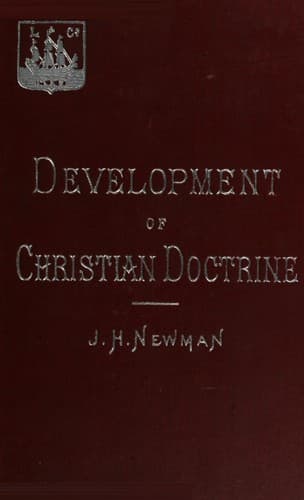
An Essay on the Development of Christian DoctrineNewman, John Henry
Religion
An Essay on the Development of Christian Doctrine
Newman, John Henry
Catholic Church -- Doctrines; Dogma, Development of
A development, converse to that which Butler speaks of, must next be
mentioned. As certain objects excite certain emotions and sentiments, so
do sentiments imply objects and duties. Thus conscience, the existence
of which we cannot deny, is a proof of the doctrine of a Moral Governor,
which alone gives it a meaning and a scope; that is, the doctrine of a
Judge and Judgment to come is a development of the phenomenon of
conscience. Again, it is plain that passions and affections are in
action in our minds before the presence of their proper objects; and
their activity would of course be an antecedent argument of extreme
cogency in behalf of the real existence of those legitimate objects,
supposing them unknown. And so again, the social principle, which is
innate in us, gives a divine sanction to society and to civil
government. And the usage of prayers for the dead implies certain
circumstances of their state upon which such devotions bear. And rites
and ceremonies are natural means through which the mind relieves itself
of devotional and penitential emotions. And sometimes the cultivation
of awe and love towards what is great, high, and unseen, has led a man
to the abandonment of his sect for some more Catholic form of doctrine.
Aristotle furnishes us with an instance of this kind of development in
his account of the happy man. After showing that his definition of
happiness includes in itself the pleasurable, which is the most obvious
and popular idea of happiness, he goes on to say that still external
goods are necessary to it, about which, however, the definition said
nothing; that is, a certain prosperity is by moral fitness, not by
logical necessity, attached to the happy man. "For it is impossible," he
observes, "or not easy, to practise high virtue without abundant means.
Many deeds are done by the instrumentality of friends, wealth and
political power; and of some things the absence is a cloud upon
happiness, as of noble birth, of hopeful children, and of personal
appearance: for a person utterly deformed, or low-born, or bereaved and
childless, cannot quite be happy: and still less if he have very
worthless children or friends, or they were good and died."[49:1]
8.
Public-domain text, read in full here on John Shaqi.
Reviews
Reviews
No reviews yet
Be the first to share your thoughts on this work.
Join the Discussion
Join the discussion
Sign in to leave a comment or review.
Sign InorCreate an account