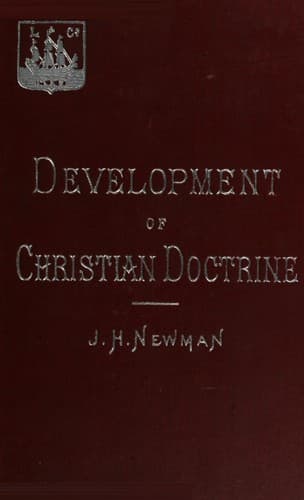
An Essay on the Development of Christian DoctrineNewman, John Henry
Religion
An Essay on the Development of Christian Doctrine
Newman, John Henry
Catholic Church -- Doctrines; Dogma, Development of
"When thus brought back to its true elements, to its essential nature,
religion appears no longer a purely personal concern, but a powerful and
fruitful principle of association. Is it considered in the light of a
system of belief, a system of dogmas? Truth is not the heritage of any
individual, it is absolute and universal; mankind ought to seek and
profess it in common. Is it considered with reference to the precepts
that are associated with its doctrines? A law which is obligatory on a
single individual, is so on all; it ought to be promulgated, and it is
our duty to endeavour to bring all mankind under its dominion. It is
the same with respect to the promises that religion makes, in the name
of its creeds and precepts; they ought to be diffused; all men should be
incited to partake of their benefits. A religious society, therefore,
naturally results from the essential elements of religion, and is such a
necessary consequence of it that the term which expresses the most
energetic social sentiment, the most intense desire to propagate ideas
and extend society, is the word _proselytism_, a term which is
especially applied to religious belief, and in fact consecrated to it.
"When a religious society has ever been formed, when a certain number of
men are united by a common religious creed, are governed by the same
religious precepts, and enjoy the same religious hopes, some form of
government is necessary. No society can endure a week, nay more, no
society can endure a single hour, without a government. The moment,
indeed, a society is formed, by the very fact of its formation, it calls
forth a government,--a government which shall proclaim the common truth
which is the bond of the society, and promulgate and maintain the
precepts that this truth ought to produce. The necessity of a superior
power, of a form of government, is involved in the fact of the existence
of a religious, as it is in that of any other society.
"And not only is a government necessary, but it naturally forms
itself. . . . When events are suffered to follow their natural laws,
when force does not interfere, power falls into the hands of the most
able, the most worthy, those who are most capable of carrying out the
principles on which the society was founded. Is a warlike expedition
in agitation? The bravest take the command. Is the object of the
association learned research, or a scientific undertaking? The best
informed will be the leader. . . . The inequality of faculties and
influence, which is the foundation of power in civil life, has the same
effect in a religious society. . . Religion has no sooner arisen in the
human mind than a religious society appears; and immediately a religious
society is formed, it produces its government."[52:1]
9.
Public-domain text, read in full here on John Shaqi.
Reviews
Reviews
No reviews yet
Be the first to share your thoughts on this work.
Join the Discussion
Join the discussion
Sign in to leave a comment or review.
Sign InorCreate an account