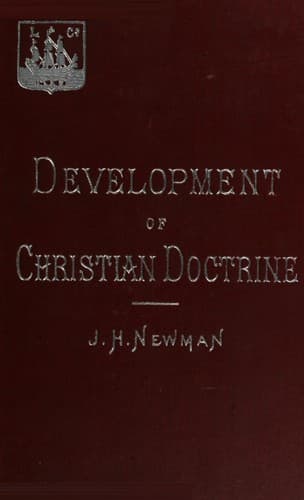
An Essay on the Development of Christian DoctrineNewman, John Henry
Religion
An Essay on the Development of Christian Doctrine
Newman, John Henry
Catholic Church -- Doctrines; Dogma, Development of
This need of an authoritative sanction is increased by considering,
after M. Guizot's suggestion, that Christianity, though represented in
prophecy as a kingdom, came into the world as an idea rather than an
institution, and has had to wrap itself in clothing and fit itself with
armour of its own providing, and to form the instruments and methods of
its prosperity and warfare. If the developments, which have above been
called _moral_, are to take place to any great extent, and without them
it is difficult to see how Christianity can exist at all, if only its
relations towards civil government have to be ascertained, or the
qualifications for the profession of it have to be defined, surely an
authority is necessary to impart decision to what is vague, and
confidence to what is empirical, to ratify the successive steps of so
elaborate a process, and to secure the validity of inferences which are
to be made the premisses of more remote investigations.
Tests, it is true, for ascertaining the correctness of developments in
general may be drawn out, as I shall show in the sequel; but they are
insufficient for the guidance of individuals in the case of so large and
complicated a problem as Christianity, though they may aid our inquiries
and support our conclusions in particular points. They are of a
scientific and controversial, not of a practical character, and are
instruments rather than warrants of right decisions. Moreover, they
rather serve as answers to objections brought against the actual
decisions of authority, than are proofs of the correctness of those
decisions. While, then, on the one hand, it is probable that some means
will be granted for ascertaining the legitimate and true developments of
Revelation, it appears, on the other, that these means must of necessity
be external to the developments themselves.
4.
Reasons shall be given in this Section for concluding that, in
proportion to the probability of true developments of doctrine and
practice in the Divine Scheme, so is the probability also of the
appointment in that scheme of an external authority to decide upon them,
thereby separating them from the mass of mere human speculation,
extravagance, corruption, and error, in and out of which they grow. This
is the doctrine of the infallibility of the Church; for by infallibility
I suppose is meant the power of deciding whether this, that, and a
third, and any number of theological or ethical statements are true.
5.
Public-domain text, read in full here on John Shaqi.
Reviews
Reviews
No reviews yet
Be the first to share your thoughts on this work.
Elsewhere in the archive
Join the Discussion
Join the discussion
Sign in to leave a comment or review.
Sign InorCreate an account