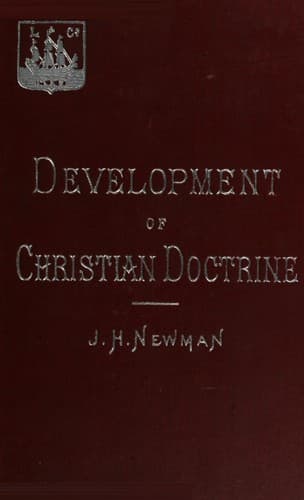
An Essay on the Development of Christian DoctrineNewman, John Henry
Religion
An Essay on the Development of Christian Doctrine
Newman, John Henry
Catholic Church -- Doctrines; Dogma, Development of
1. Let the state of the case be carefully considered. If the Christian
doctrine, as originally taught, admits of true and important
developments, as was argued in the foregoing Section, this is a strong
antecedent argument in favour of a provision in the Dispensation for
putting a seal of authority upon those developments. The probability of
their being known to be true varies with that of their truth. The two
ideas indeed are quite distinct, I grant, of revealing and of
guaranteeing a truth, and they are often distinct in fact. There are
various revelations all over the earth which do not carry with them the
evidence of their divinity. Such are the inward suggestions and secret
illuminations granted to so many individuals; such are the traditionary
doctrines which are found among the heathen, that "vague and unconnected
family of religious truths, originally from God, but sojourning, without
the sanction of miracle or a definite home, as pilgrims up and down the
world, and discernible and separable from the corrupt legends with which
they are mixed, by the spiritual mind alone."[79:1] There is nothing
impossible in the notion of a revelation occurring without evidences
that it is a revelation; just as human sciences are a divine gift, yet
are reached by our ordinary powers and have no claim on our faith. But
Christianity is not of this nature: it is a revelation which comes to us
as a revelation, as a whole, objectively, and with a profession of
infallibility; and the only question to be determined relates to the
matter of the revelation. If then there are certain great truths, or
duties, or observances, naturally and legitimately resulting from the
doctrines originally professed, it is but reasonable to include these
true results in the idea of the revelation itself, to consider them
parts of it, and if the revelation be not only true, but guaranteed as
true, to anticipate that they too will come under the privilege of that
guarantee. Christianity, unlike other revelations of God's will, except
the Jewish, of which it is a continuation, is an objective religion, or
a revelation with credentials; it is natural, I say, to view it wholly
as such, and not partly _sui generis_, partly like others. Such as it
begins, such let it be considered to continue; granting that certain
large developments of it are true, they must surely be accredited as
true.
6.
Public-domain text, read in full here on John Shaqi.
Reviews
Reviews
No reviews yet
Be the first to share your thoughts on this work.
Elsewhere in the archive
Join the Discussion
Join the discussion
Sign in to leave a comment or review.
Sign InorCreate an account