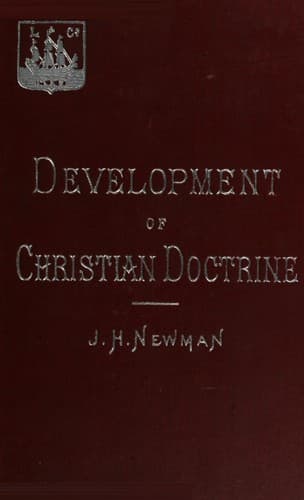
An Essay on the Development of Christian DoctrineNewman, John Henry
Religion
An Essay on the Development of Christian Doctrine
Newman, John Henry
Catholic Church -- Doctrines; Dogma, Development of
inconsistent in this idea? Whatever then be the particular means of
determining infallibility, the abstract objection may be put
aside.[81:2]
8.
3. Again, it is sometimes argued that such a dispensation would destroy
our probation, as dissipating doubt, precluding the exercise of faith,
and obliging us to obey whether we wish it or no; and it is urged that a
Divine Voice spoke in the first age, and difficulty and darkness rest
upon all subsequent ones; as if infallibility and personal judgment were
incompatible; but this is to confuse the subject. We must distinguish
between a revelation and a reception of it, not between its earlier and
later stages. A revelation, in itself divine, and guaranteed as such,
may from first to last be received, doubted, argued against, perverted,
rejected, by individuals according to the state of mind of each.
Ignorance, misapprehension, unbelief, and other causes, do not at once
cease to operate because the revelation is in itself true and in its
proofs irrefragable. We have then no warrant at all for saying that an
accredited revelation will exclude the existence of doubts and
difficulties on the part of those whom it addresses, or dispense with
anxious diligence on their part, though it may in its own nature tend
to do so. Infallibility does not interfere with moral probation; the two
notions are absolutely distinct. It is no objection then to the idea of
a peremptory authority, such as I am supposing, that it lessens the task
of personal inquiry, unless it be an objection to the authority of
Revelation altogether. A Church, or a Council, or a Pope, or a Consent
of Doctors, or a Consent of Christendom, limits the inquiries of the
individual in no other way than Scripture limits them: it does limit
them; but, while it limits their range, it preserves intact their
probationary character; we are tried as really, though not on so large a
field. To suppose that the doctrine of a permanent authority in matters
of faith interferes with our free-will and responsibility is, as before,
to forget that there were infallible teachers in the first age, and
heretics and schismatics in the ages subsequent. There may have been at
once a supreme authority from first to last, and a moral judgment from
first to last. Moreover, those who maintain that Christian truth must be
gained solely by personal efforts are bound to show that methods,
ethical and intellectual, are granted to individuals sufficient for
gaining it; else the mode of probation they advocate is less, not more,
perfect than that which proceeds upon external authority. On the whole,
then, no argument against continuing the principle of objectiveness into
the developments of Revelation arises out of the conditions of our moral
responsibility.
9.
Public-domain text, read in full here on John Shaqi.
Reviews
Reviews
No reviews yet
Be the first to share your thoughts on this work.
Elsewhere in the archive
Join the Discussion
Join the discussion
Sign in to leave a comment or review.
Sign InorCreate an account