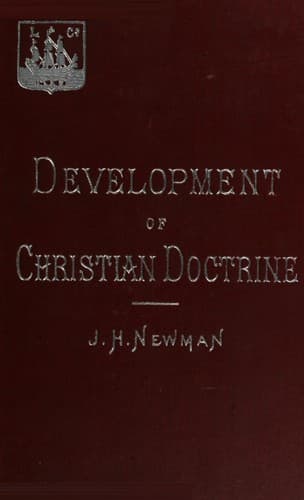
An Essay on the Development of Christian DoctrineNewman, John Henry
Religion
An Essay on the Development of Christian Doctrine
Newman, John Henry
Catholic Church -- Doctrines; Dogma, Development of
2. An objection, however, is often made to the doctrine of infallibility
_in limine_, which is too important not to be taken into consideration.
It is urged that, as all religious knowledge rests on moral evidence,
not on demonstration, our belief in the Church's infallibility must be
of this character; but what can be more absurd than a probable
infallibility, or a certainty resting on doubt?--I believe, because I am
sure; and I am sure, because I suppose. Granting then that the gift of
infallibility be adapted, when believed, to unite all intellects in one
common confession, the fact that it is given is as difficult of proof as
the developments which it is to prove, and nugatory therefore, and in
consequence improbable in a Divine Scheme. The advocates of Rome, it has
been urged, "insist on the necessity of an infallible guide in religious
matters, as an argument that such a guide has really been accorded. Now
it is obvious to inquire how individuals are to know with certainty that
Rome _is_ infallible . . . how any ground can be such as to bring home
to the mind infallibly that she is infallible; what conceivable proof
amounts to more than a probability of the fact; and what advantage is an
infallible guide, if those who are to be guided have, after all, no
more than an opinion, as the Romanists call it, that she is
infallible?"[81:1]
7.
This argument, however, except when used, as is intended in this
passage, against such persons as would remove all imperfection in
the proof of Religion, is certainly a fallacious one. For since,
as all allow, the Apostles were infallible, it tells against their
infallibility, or the infallibility of Scripture, as truly as against
the infallibility of the Church; for no one will say that the Apostles
were made infallible for nothing, yet we are only morally certain that
they were infallible. Further, if we have but probable grounds for the
Church's infallibility, we have but the like for the impossibility of
certain things, the necessity of others, the truth, the certainty of
others; and therefore the words _infallibility_, _necessity_, _truth_,
and _certainty_ ought all of them to be banished from the language. But
why is it more inconsistent to speak of an uncertain infallibility than
of a doubtful truth or a contingent necessity, phrases which present
ideas clear and undeniable? In sooth we are playing with words when we
use arguments of this sort. When we say that a person is infallible, we
mean no more than that what he says is always true, always to be
believed, always to be done. The term is resolvable into these phrases
as its equivalents; either then the phrases are inadmissible, or the
idea of infallibility must be allowed. A probable infallibility is a
probable gift of never erring; a reception of the doctrine of a probable
infallibility is faith and obedience towards a person founded on the
probability of his never erring in his declarations or commands. What is
Public-domain text, read in full here on John Shaqi.
Reviews
Reviews
No reviews yet
Be the first to share your thoughts on this work.
Elsewhere in the archive
Join the Discussion
Join the discussion
Sign in to leave a comment or review.
Sign InorCreate an account