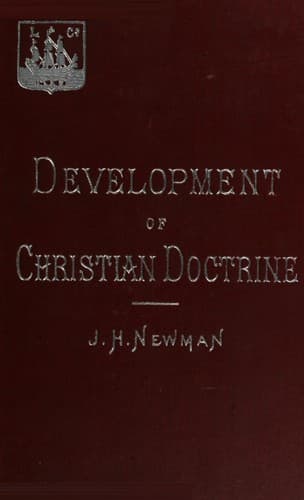
An Essay on the Development of Christian DoctrineNewman, John Henry
Religion
An Essay on the Development of Christian Doctrine
Newman, John Henry
Catholic Church -- Doctrines; Dogma, Development of
But it is otherwise with history, the facts of which are not present; it
is otherwise with ethics, in which phenomena are more subtle, closer,
and more personal to individuals than other facts, and not referable to
any common standard by which all men can decide upon them. In such
sciences, we cannot rest upon mere facts, if we would, because we have
not got them. We must do our best with what is given us, and look about
for aid from any quarter; and in such circumstances the opinions of
others, the traditions of ages, the prescriptions of authority,
antecedent auguries, analogies, parallel cases, these and the like, not
indeed taken at random, but, like the evidence from the senses, sifted
and scrutinized, obviously become of great importance.
2.
And, further, if we proceed on the hypothesis that a merciful Providence
has supplied us with means of gaining such truth as concerns us, in
different subject-matters, though with different instruments, then the
simple question is, what those instruments are which are proper to a
particular case. If they are of the appointment of a Divine Protector,
we may be sure that they will lead to the truth, whatever they are. The
less exact methods of reasoning may do His work as well as the more
perfect, if He blesses them. He may bless antecedent probabilities in
ethical inquiries, who blesses experience and induction in the art of
medicine.
And if it is reasonable to consider medicine, or architecture, or
engineering, in a certain sense, divine arts, as being divinely ordained
means of our receiving divine benefits, much more may ethics be called
divine; while as to religion, it directly professes to be the method of
recommending ourselves to Him and learning His will. If then it be His
gracious purpose that we should learn it, the means He gives for
learning it, be they promising or not to human eyes, are sufficient,
because they are His. And what they are at this particular time, or to
this person, depends on His disposition. He may have imposed simple
prayer and obedience on some men as the instrument of their attaining to
the mysteries and precepts of Christianity. He may lead others through
the written word, at least for some stages of their course; and if the
formal basis on which He has rested His revelations be, as it is, of an
historical and philosophical character, then antecedent probabilities,
subsequently corroborated by facts, will be sufficient, as in the
parallel case of other history, to bring us safely to the matter, or at
least to the organ, of those revelations.
3.
Public-domain text, read in full here on John Shaqi.
Reviews
Reviews
No reviews yet
Be the first to share your thoughts on this work.
Elsewhere in the archive
Join the Discussion
Join the discussion
Sign in to leave a comment or review.
Sign InorCreate an account