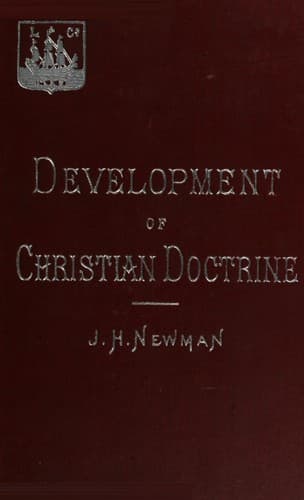
An Essay on the Development of Christian DoctrineNewman, John Henry
Religion
An Essay on the Development of Christian Doctrine
Newman, John Henry
Catholic Church -- Doctrines; Dogma, Development of
Moreover, in subjects which belong to moral proof, such, I mean, as
history, antiquities, political science, ethics, metaphysics, and
theology, which are pre-eminently such, and especially in theology and
ethics, antecedent probability may have a real weight and cogency which
it cannot have in experimental science; and a mature politician or
divine may have a power of reaching matters of fact in consequence of
his peculiar habits of mind, which is seldom given in the same degree to
physical inquirers, who, for the purposes of this particular pursuit,
are very much on a level. And this last remark at least is confirmed by
Lord Bacon, who confesses "Our method of discovering the sciences does
not much depend upon subtlety and strength of genius, but lies level to
almost every capacity and understanding;"[113:1] though surely sciences
there are, in which genius is everything, and rules all but nothing.
4.
It will be a great mistake then to suppose that, because this eminent
philosopher condemned presumption and prescription in inquiries into
facts which are external to us, present with us, and common to us all,
therefore authority, tradition, verisimilitude, analogy, and the like,
are mere "idols of the den" or "of the theatre" in history or ethics.
Here we may oppose to him an author in his own line as great as he is:
"Experience," says Bacon, "is by far the best demonstration, provided it
dwell in the experiment; for the transferring of it to other things
judged alike is very fallacious, unless done with great exactness and
regularity."[113:2] Niebuhr explains or corrects him: "Instances are not
arguments," he grants, when investigating an obscure question of Roman
history,--"instances are not arguments, but in history are scarcely of
less force; above all, where the parallel they exhibit is in the
progressive development of institutions."[113:3] Here this sagacious
writer recognizes the true principle of historical logic, while he
exemplifies it.
The same principle is involved in the well-known maxim of Aristotle,
that "it is much the same to admit the probabilities of a mathematician,
and to look for demonstration from an orator." In all matters of human
life, presumption verified by instances, is our ordinary instrument of
proof, and, if the antecedent probability is great, it almost
supersedes instances. Of course, as is plain, we may err grievously in
the antecedent view which we start with, and in that case, our
conclusions may be wide of the truth; but that only shows that we had no
right to assume a premiss which was untrustworthy, not that our
reasoning was faulty.
5.
Public-domain text, read in full here on John Shaqi.
Reviews
Reviews
No reviews yet
Be the first to share your thoughts on this work.
Elsewhere in the archive
Join the Discussion
Join the discussion
Sign in to leave a comment or review.
Sign InorCreate an account