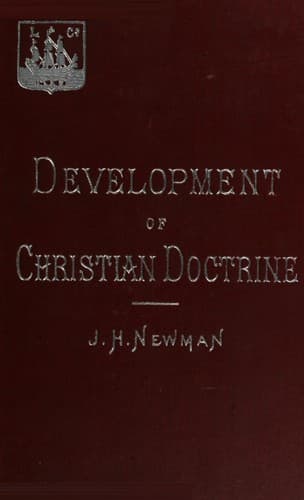
An Essay on the Development of Christian DoctrineNewman, John Henry
Religion
An Essay on the Development of Christian Doctrine
Newman, John Henry
Catholic Church -- Doctrines; Dogma, Development of
But there is more to say on the subordinate position which direct
evidence holds among the _motiva_ of conviction in most matters. It is
no paradox to say that there is a certain scantiness, nay an absence of
evidence, which may even tell in favour of statements which require to
be made good. There are indeed cases in which we cannot discover the law
of silence or deficiency, which are then simply unaccountable. Thus
Lucian, for whatever reason, hardly notices Roman authors or
affairs.[115:1] Maximus Tyrius, who wrote several of his works at Rome,
nevertheless makes no reference to Roman history. Paterculus, the
historian, is mentioned by no ancient writer except Priscian. What is
more to our present purpose, Seneca, Pliny the elder, and Plutarch are
altogether silent about Christianity; and perhaps Epictetus also, and
the Emperor Marcus. The Jewish Mishna, too, compiled about A.D. 180, is
silent about Christianity; and the Jerusalem and Babylonish Talmuds
almost so, though the one was compiled about A.D. 300, and the other
A.D. 500.[115:2] Eusebius again, is very uncertain in his notice of
facts: he does not speak of St. Methodius, nor of St. Anthony, nor of
the martyrdom of St. Perpetua, nor of the miraculous powers of St.
Gregory Thaumaturgus; and he mentions Constantine's luminous cross, not
in his Ecclesiastical History, where it would naturally find a place,
but in his Life of the Emperor. Moreover, those who receive that
wonderful occurrence, which is, as one who rejects it allows,[116:1] "so
inexplicable to the historical inquirer," have to explain the difficulty
of the universal silence on the subject of all the Fathers of the fourth
and fifth centuries, excepting Eusebius.
In like manner, Scripture has its unexplained omissions. No religious
school finds its own tenets and usages on the surface of it. The remark
applies also to the very context of Scripture, as in the obscurity which
hangs over Nathanael or the Magdalen. It is a remarkable circumstance
that there is no direct intimation all through Scripture that the
Serpent mentioned in the temptation of Eve was the evil spirit, till we
come to the vision of the Woman and Child, and their adversary, the
Dragon, in the twelfth chapter of the Apocalypse.
7.
Public-domain text, read in full here on John Shaqi.
Reviews
Reviews
No reviews yet
Be the first to share your thoughts on this work.
Elsewhere in the archive
Join the Discussion
Join the discussion
Sign in to leave a comment or review.
Sign InorCreate an account