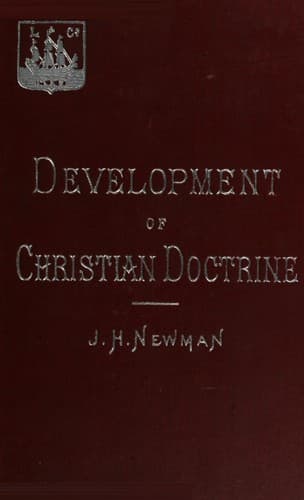
An Essay on the Development of Christian DoctrineNewman, John Henry
Religion
An Essay on the Development of Christian Doctrine
Newman, John Henry
Catholic Church -- Doctrines; Dogma, Development of
I am speaking of the process itself, and its correctness is shown by its
general adoption. In religious questions a single text of Scripture is
all-sufficient with most people, whether the well disposed or the
prejudiced, to prove a doctrine or a duty in cases when a custom is
established or a tradition is strong. "Not forsaking the assembling of
ourselves together" is sufficient for establishing social, public, nay,
Sunday worship. "Where the tree falleth, there shall it lie," shows that
our probation ends with life. "Forbidding to marry" determines the Pope
to be the man of sin. Again, it is plain that a man's after course for
good or bad brings out the passing words or obscure actions of previous
years. Then, on a retrospect, we use the event as a presumptive
interpretation of the past, of those past indications of his character
which, considered as evidence, were too few and doubtful to bear
insisting on at the time, and would have seemed ridiculous, had we
attempted to do so. And the antecedent probability is even found to
triumph over contrary evidence, as well as to sustain what agrees with
it. Every one may know of cases in which a plausible charge against an
individual was borne down at once by weight of character, though that
character was incommensurate of course with the circumstances which gave
rise to suspicion, and had no direct neutralizing force to destroy it.
On the other hand, it is sometimes said, and even if not literally true
will serve in illustration, that not a few of those who are put on trial
in our criminal courts are not legally guilty of the particular crime on
which a verdict is found against them, being convicted not so much upon
the particular evidence, as on the presumption arising from their want
of character and the memory of their former offences. Nor is it in
slight matters only or unimportant that we thus act. Our dearest
interests, our personal welfare, our property, our health, our
reputation, we freely hazard, not on proof, but on a simple probability,
which is sufficient for our conviction, because prudence dictates to us
so to take it. We must be content to follow the law of our being in
religious matters as well as in secular.
6.
Public-domain text, read in full here on John Shaqi.
Reviews
Reviews
No reviews yet
Be the first to share your thoughts on this work.
Elsewhere in the archive
Join the Discussion
Join the discussion
Sign in to leave a comment or review.
Sign InorCreate an account