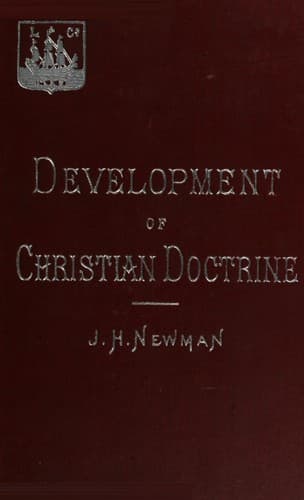
An Essay on the Development of Christian DoctrineNewman, John Henry
Religion
An Essay on the Development of Christian Doctrine
Newman, John Henry
Catholic Church -- Doctrines; Dogma, Development of
Accordingly, some writers have gone on to give reasons from history for
their refusing to appeal to history. They aver that, when they come to
look into the documents and literature of Christianity in times past,
they find its doctrines so variously represented, and so inconsistently
maintained by its professors, that, however natural it be _à priori_, it
is useless, in fact, to seek in history the matter of that Revelation
which has been vouchsafed to mankind; that they cannot be historical
Christians if they would. They say, in the words of Chillingworth,
"There are popes against popes, councils against councils, some fathers
against others, the same fathers against themselves, a consent of
fathers of one age against a consent of fathers of another age, the
Church of one age against the Church of another age:"--Hence they are
forced, whether they will or not, to fall back upon the Bible as the
sole source of Revelation, and upon their own personal private judgment
as the sole expounder of its doctrine. This is a fair argument, if it
can be maintained, and it brings me at once to the subject of this
Essay. Not that it enters into my purpose to convict of misstatement, as
might be done, each separate clause of this sweeping accusation of a
smart but superficial writer; but neither on the other hand do I mean
to deny everything that he says to the disadvantage of historical
Christianity. On the contrary, I shall admit that there are in fact
certain apparent variations in its teaching, which have to be explained;
thus I shall begin, but then I shall attempt to explain them to the
exculpation of that teaching in point of unity, directness, and
consistency.
5.
Meanwhile, before setting about this work, I will address one remark to
Chillingworth and his friends:--Let them consider, that if they can
criticize history, the facts of history certainly can retort upon them.
It might, I grant, be clearer on this great subject than it is. This is
no great concession. History is not a creed or a catechism, it gives
lessons rather than rules; still no one can mistake its general teaching
in this matter, whether he accept it or stumble at it. Bold outlines and
broad masses of colour rise out of the records of the past. They may be
dim, they may be incomplete; but they are definite. And this one thing
at least is certain; whatever history teaches, whatever it omits,
whatever it exaggerates or extenuates, whatever it says and unsays, at
least the Christianity of history is not Protestantism. If ever there
were a safe truth, it is this.
Public-domain text, read in full here on John Shaqi.
Reviews
Reviews
No reviews yet
Be the first to share your thoughts on this work.
Join the Discussion
Join the discussion
Sign in to leave a comment or review.
Sign InorCreate an account