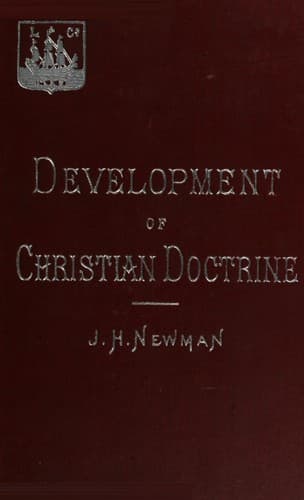
An Essay on the Development of Christian DoctrineNewman, John Henry
Religion
An Essay on the Development of Christian Doctrine
Newman, John Henry
Catholic Church -- Doctrines; Dogma, Development of
On what ground, then, do we receive the Canon as it comes to us, but on
the authority of the Church of the fourth and fifth centuries? The
Church at that era decided--not merely bore testimony, but passed a
judgment on former testimony,--decided, that certain books were of
authority. And on what ground did she so decide? on the ground that
hitherto a decision had been impossible, in an age of persecution, from
want of opportunities for research, discussion, and testimony, from the
private or the local character of some of the books, and from
misapprehension of the doctrine contained in others. Now, however,
facilities were at length given for deciding once for all on what had
been in suspense and doubt for three centuries. On this subject I will
quote another passage from the same Tract: "We depend upon the fourth
and fifth centuries thus:--As to Scripture, former centuries do not
speak distinctly, frequently, or unanimously, except of some chief
books, as the Gospels; but we see in them, as we believe, an
ever-growing tendency and approximation to that full agreement which we
find in the fifth. The testimony given at the latter date is the limit
to which all that has been before said converges. For instance, it is
commonly said, _Exceptio probat regulam_; when we have reason to think
that a writer or an age would have witnessed so and so, _but for_ this
or that, and that this or that were mere accidents of his position, then
he or it may be said to _tend towards_ such testimony. In this way the
first centuries tend towards the fifth. Viewing the matter as one of
moral evidence, we seem to see in the testimony of the fifth the very
testimony which every preceding century gave, accidents excepted, such
as the present loss of documents once extant, or the then existing
misconceptions which want of intercourse between the Churches
occasioned. The fifth century acts as a comment on the obscure text of
the centuries before it, and brings out a meaning, which with the help
of the comment any candid person sees really to be theirs."[126:1]
4.
(2.) _Original Sin._
Public-domain text, read in full here on John Shaqi.
Reviews
Reviews
No reviews yet
Be the first to share your thoughts on this work.
Elsewhere in the archive
Join the Discussion
Join the discussion
Sign in to leave a comment or review.
Sign InorCreate an account