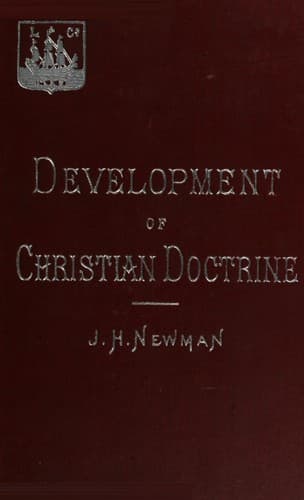
An Essay on the Development of Christian DoctrineNewman, John Henry
Religion
An Essay on the Development of Christian Doctrine
Newman, John Henry
Catholic Church -- Doctrines; Dogma, Development of
I have already remarked upon the historical fact, that the recognition
of Original Sin, considered as the consequence of Adam's fall, was, both
as regards general acceptance and accurate understanding, a gradual
process, not completed till the time of Augustine and Pelagius. St.
Chrysostom lived close up to that date, but there are passages in his
works, often quoted, which we should not expect to find worded as they
stand, if they had been written fifty years later. It is commonly, and
reasonably, said in explanation, that the fatalism, so prevalent in
various shapes pagan and heretical, in the first centuries, was an
obstacle to an accurate apprehension of the consequences of the fall, as
the presence of the existing idolatry was to the use of images. If this
be so, we have here an instance of a doctrine held back for a time by
circumstances, yet in the event forcing its way into its normal shape,
and at length authoritatively fixed in it, that is, of a doctrine held
implicitly, then asserting itself, and at length fully developed.
5.
(3.) _Infant Baptism._
One of the passages of St. Chrysostom to which I might refer is this,
"We baptize infants, though they are not defiled with sin, that they may
receive sanctity, righteousness, adoption, heirship, brotherhood with
Christ, and may become His members." (_Aug. contr. Jul._ i. 21.) This at
least shows that he had a clear view of the importance and duty of
infant baptism, but such was not the case even with saints in the
generation immediately before him. As is well known, it was not unusual
in that age of the Church for those, who might be considered
catechumens, to delay their baptism, as Protestants now delay reception
of the Holy Eucharist. It is difficult for us at this day to enter into
the assemblage of motives which led to this postponement; to a keen
sense and awe of the special privileges of baptism which could only once
be received, other reasons would be added,--reluctance to being
committed to a strict rule of life, and to making a public profession of
religion, and to joining in a specially intimate fellowship or
solidarity with strangers. But so it was in matter of fact, for reasons
good or bad, that infant baptism, which is a fundamental rule of
Christian duty with us, was less earnestly insisted on in early times.
6.
Public-domain text, read in full here on John Shaqi.
Reviews
Reviews
No reviews yet
Be the first to share your thoughts on this work.
Elsewhere in the archive
Join the Discussion
Join the discussion
Sign in to leave a comment or review.
Sign InorCreate an account