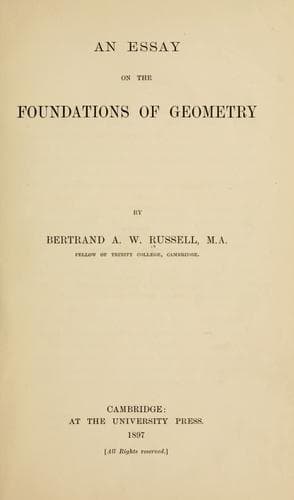
An essay on the foundations of geometryRussell, Bertrand
Philosophy
An essay on the foundations of geometry
Russell, Bertrand
Geometry -- Foundations
=91.= The mathematical criticism begins (§ 131) with a somewhat
question-begging definition of parallel straight lines. Two straight
lines _aα_, _bβ_, according to this definition, are parallel
when--_a_ and _b_ being arbitrary points on the two lines--if _aα_
= _bβ_, then _ab_ = _αβ_, where _α_, _β_ are two other points on the
two straight lines respectively. This definition--which contains
Euclid's axiom and definition combined in a very convenient and
enticing form--is of course thoroughly suitable to Euclidean
Geometry, and leads immediately to all the Euclidean propositions
about parallels. But it is perhaps more honest to follow Euclid's
course; when an axiom is thus buried in a definition, it is apt to
seem, since definitions are supposed to be arbitrary, as though the
difficulty had been overcome, while in reality, the possibility of
parallels, as above defined, involves the very point in question,
namely, the disputed axiom of parallels. For what this axiom asserts
is simply the existence of lines conforming to Lotze's definition.
The deduction of the principal propositions on parallels, with
which Lotze follows up his definition, is of course a very simple
proceeding--a proceeding, however, in which the first step begs the
question.
=92.= The next argument for the apriority of Euclidean Geometry has,
oddly enough, an exactly opposite bearing, although it is a great
favourite with opponents of Metageometry. Measurements of stellar
triangles, and all similar attempts at an empirical determination
of the space-constant are, according to Lotze, beside the mark; for
any observed departure from two right angles, or any finite annual
parallax for distant stars, would be attributed to some new kind of
refraction, or, as in the case of aberration, to some other physical
cause, and never to the geometrical nature of space. This is a
strong argument for the empirical validity of Euclid, but as an
argument for the apodeictic certainty of the orthodox system, it has
an opposite tendency. For observations of the kind contemplated would
have to be due to departures from Euclidean straightness, hitherto
unknown, on the part of stellar light-rays. Such departure could,
in certain cases, be accounted for by a finite space-constant, but
it could also, probably, be accounted for by a change in Optics,
for example, by attributing refractive properties to the ether.
Such properties could only exist if ether were of varying density,
if (say) it were denser in the neighbourhood of any of the heavenly
bodies. But such an assumption would, I believe, destroy the utility
of ether for Physics; a slight alteration in our Geometry, so slight
as not appreciably to affect distances within the Solar System,
would probably be in the end, therefore, should such errors ever
be discovered, a simpler explanation than any that Physics could
offer. But this is not the point of my contention. The point is
that, if the physical explanation, as Lotze holds, be possible in
Public-domain text, read in full here on John Shaqi.
Reviews
Reviews
No reviews yet
Be the first to share your thoughts on this work.
Elsewhere in the archive
Join the Discussion
Join the discussion
Sign in to leave a comment or review.
Sign InorCreate an account