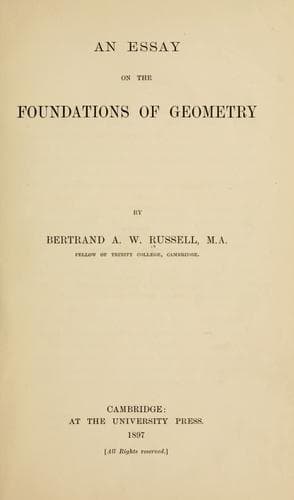
An essay on the foundations of geometryRussell, Bertrand
Philosophy
An essay on the foundations of geometry
Russell, Bertrand
Geometry -- Foundations
the above case, the converse must also hold: it must be possible to
explain the present phenomena by supposing ether refractive and space
non-Euclidean. From this conclusion there is no escape. If every
conceivable behaviour of light-rays can be explained, within Euclid,
by physical causes, it must also be possible, by a suitable choice
of hypothetical physical causes, to explain the actual phenomena
as belonging to a non-Euclidean space. Such a hypothesis would be
rightly rejected by Science, for the present, on account of its
unnecessary complexity. Nevertheless it would remain, for philosophy,
a possibility to be reckoned with, and the choice could only be
decided upon empirical grounds of simplicity. It may well be doubted
whether, in the world we know, the phenomena could be attributed
to a distinctly non-Euclidean space, but this conclusion follows
inevitably from the contention that no phenomena could force us to
assume such a space. Lotze's argument, therefore, if pushed home,
disproves his own view, and puts Euclidean space, as an empirical
explanation of phenomena, on a level with luminiferous ether[103].
=93.= Lotze now proceeds (§ 132) to a detailed criticism of
Helmholtz, whom he regards as a typical exponent of Metageometry.
It is possible that, at the time when he wrote, Helmholtz really
did occupy this position; but it is unfortunate that, in the minds
of philosophers, he should still continue to do so, after the very
material advances brought about by the projective treatment of the
subject. It is also unfortunate that his somewhat careless attempts
to popularise mathematical results have so often been disposed of,
without due attention to his more technical and solid contributions.
Thus his romances about Flatland and Sphereland--at best only
fairy-tale analogies of doubtful value--have been attacked as if they
formed an essential feature of Metageometry.
But to proceed to particulars: Lotze readily allows that the
Flatlanders would set up Plane Geometry, as we know it, but refuses
to admit that the Spherelanders could, without inferring the third
dimension, set up a two-dimensional spherical Geometry which should
be free from contradictions. I will endeavour to give a free
rendering of Lotze's argument on this point.
[Illustration]
Public-domain text, read in full here on John Shaqi.
Reviews
Reviews
No reviews yet
Be the first to share your thoughts on this work.
Elsewhere in the archive
Join the Discussion
Join the discussion
Sign in to leave a comment or review.
Sign InorCreate an account