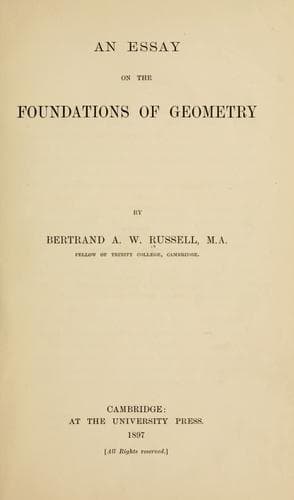
An essay on the foundations of geometryRussell, Bertrand
Philosophy
An essay on the foundations of geometry
Russell, Bertrand
Geometry -- Foundations
In this argument it is difficult--to me at any rate--to see any
force at all. The only way I can account for it is, to suppose that
Lotze has neglected the possibility of any but single infinities.
On this interpretation, the argument might be stated thus: There is
an infinite series of continuously varying _OY_'s; to the common
property of these, we add another property, which will divide their
total number by infinity. The remaining _OZ_, therefore, must be
uniquely determined. The same form of argument, however, would prove
that two surfaces can only cut one another in a single point, and
numberless other absurdities. The fact is, that infinities may be of
different orders. For example, the number of points in a line may be
taken as a single infinity, and so may the number of lines in a plane
through any point; hence, by multiplication, the number of points in
a plane is a double infinity, ∞^{2}, and if we divide this number
by a single infinity, we get still an infinite number left. Thus
Lotze's argument assumes what he has to prove, that the number of
lines perpendicular to a given line, through any point, is a single
infinity, which is equivalent to the axiom of three dimensions. The
whole passage is so obscure, that its meaning may have escaped me. It
is obvious _à priori_, however, as I pointed out in the beginning,
that any proof of the axiom must be fallacious somewhere, and the
above interpretation of the argument is the only one I have been able
to find.
=95.= The rest of the Chapter is devoted to an attack on spherical
and pseudo-spherical space, on the ground that they interfere with
the homogeneity of the three dimensions, and with the similarity
of all parts of space. This is simply false. Such spaces, like the
surface of a sphere, _are_ exactly alike throughout. Lotze shows,
here and elsewhere, that he has not taken the pains to find out
what Metageometry really is. I hold myself, and have tried to prove
in this Essay, that Congruence is an _à priori_ axiom, without
which Geometry would be impossible; but the wish to uphold this
axiom is, as Lotze ought to have known, the precise motive which
led Metageometry to limit itself to spaces of constant measure of
curvature. We see here the importance of distinguishing between
Helmholtz the philosopher and Helmholtz the mathematician. Though the
philosopher wished to dispense with Congruence, the mathematician, as
we saw in Chapter I., retained and strongly emphasized it. A little
later Lotze shows, again, how he has been misled by the unfortunate
analogy of Sphereland. A spherical _surface_, he says, he can
understand; but how are we to pass from this to a spherical space?
Either this surface is the whole of our space, as in Sphereland, or
it generates space by a gradually growing radius. Such concentric
spheres, as Lotze triumphantly points out, of course generate
Euclidean space. His disjunction, however, is utterly and entirely
Public-domain text, read in full here on John Shaqi.
Reviews
Reviews
No reviews yet
Be the first to share your thoughts on this work.
Elsewhere in the archive
Join the Discussion
Join the discussion
Sign in to leave a comment or review.
Sign InorCreate an account