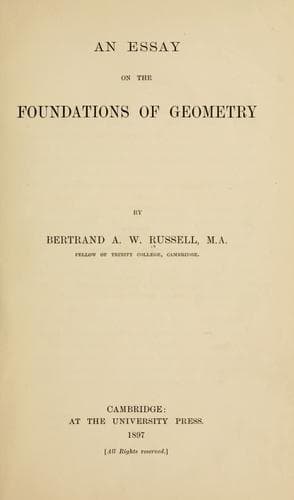
An essay on the foundations of geometryRussell, Bertrand
Philosophy
An essay on the foundations of geometry
Russell, Bertrand
Geometry -- Foundations
I have contended that, on the contrary, nothing
would force the Spherelanders to assume a third dimension, while they
would find it impossible exactly as we find a fourth impossible--not
logically, that is to say, but only as a presentable construction in
given space.
After a somewhat elephantine piece of humour, about socialistic
whales in a four-dimensional sea of Fourrier's _eau sucrée_, Lotze
proceeds to a proof, by logic, that every form of intuition, which
embraces the whole system of ordered relations of a coexisting
manifold, _must_ have three dimensions. One might object, on _à
priori_ grounds, to any such attempt: what belongs to pure intuition
could hardly, one would have thought, be determined by _à priori_
reasoning[107]. I will not, however, develop this argument here,
but endeavour to point out, as far as its obscurity will allow, the
particular fallacy of the proof in question.
[Illustration]
Lotze's argument is as follows. In this discussion, though our
terminology is necessarily taken from space, we are really concerned
with a much more general conception. We assume, in order to preserve
the homogeneity of dimensions, that the difference (distance) between
any two elements (points) of our manifold--to borrow Riemann's
word--is of the same kind as, and commensurable with, the difference
between any other two elements. Let us take a series of elements at
successive distances _x_ such that the distance between any two is
the sum of the distances between intermediate elements. Such a series
corresponds to a straight line, which is taken as the _x_-axis. Then
a series _OY_ is called perpendicular to the _x_-axis _OX_, when
the distances of any element _y_, on _OY_, from +_mx_ and -_mx_ are
equal. By our hypothesis, these distances are comparable with, and
qualitatively similar to, _x_ and _y_. So long as _OY_ is defined
only by relation to _OX_, it is conceptually unique. But now let
us suppose the same relation as that between _OX_ and _OY_, to be
possible between _OY_ and a new series _OZ_; we then get a third
series _OZ_ perpendicular to _OY_, and again conceptually unique, so
long as it is defined by relation to _OY_ alone. We might proceed,
in the same way, to a fourth line _OU_ perpendicular to _OZ_. But it
is necessary, for our purposes, that _OZ_ should be perpendicular to
_OX_ as well as _OY_. Without this condition, _OZ_ might extend into
another world, and have no corresponding relation to _OX_--this is a
possibility only excluded by our unavoidable spatial images. At this
point comes the crux of the argument. _That OZ_, says Lotze, which,
besides being perpendicular to _OY_, is also perpendicular to _OX_,
must be among the series of _OY_'s, for these were defined only by
perpendicularity to _OX_. _Hence_, he concludes, there can only be
even a third dimension if _OZ_ coincides with one, and--as soon as
_OX_ is considered fixed--with _only_ one, of the many members of the
_OY_ series.
Public-domain text, read in full here on John Shaqi.
Reviews
Reviews
No reviews yet
Be the first to share your thoughts on this work.
Elsewhere in the archive
Join the Discussion
Join the discussion
Sign in to leave a comment or review.
Sign InorCreate an account