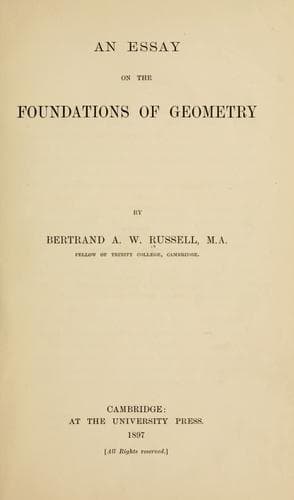
An essay on the foundations of geometryRussell, Bertrand
Philosophy
An essay on the foundations of geometry
Russell, Bertrand
Geometry -- Foundations
=99.= Now we saw, in discussing Erdmann's views of the judgment of
quantity, that in non-Euclidean space, as in Euclidean, a change
of all spatial magnitudes, in the same ratio, would be no change
at all; the ratios of all magnitudes to the space-constant would
be unchanged, and the space-constant, as the ultimate standard of
comparison, cannot, in any intelligible sense, be said to have any
particular magnitude. The absolute magnitudes of Metageometry,
therefore, are absolute only as against any other _particular_
magnitude, not as against other magnitudes in general. If this were
not the case, the comparative nature of the judgment of magnitude
would be contradicted, and metrical Metageometry would become absurd.
But as it is, the difference from Euclid consists only in this: that
in Metageometry we have, while in Euclid we have not, a standard of
comparison involved in the nature of our space as a whole, which we
call the space-constant. We have to discuss whether the assertion of
such a standard involves an undue reification of space.
I do not believe that this is the case. For an undue reification of
space would only arise, if we were no longer able to regard position
as wholly relative, and as geometrically definable only by departure
from other positions. But the relativity of position, as we have
abundantly seen, is preserved by all spaces of constant curvature--in
all of these, positions can only be defined, geometrically, by
relations to fresh positions[111]. This series of definitions may
lead to an infinite regress, but it may also, as in spherical space,
form a vicious circle, and return again to the position from which
it started. No reification of space, no independent existence of
mere relations, seems involved in such a procedure. The whole of
Metageometry, in short, is a proof that the relativity of position
is compatible with absolute magnitude, in the only sense required
by non-Euclidean spaces. We must conclude, therefore, that there
is nothing incompatible, in a denial of homogeneity (in Delbœuf's
sense), either with the relational nature of space, or with the
comparative nature of magnitude. This last _à priori_ objection to
Metageometry, therefore, cannot be maintained, and the issue must be
decided on empirical grounds alone.
=100.= The foundations of Geometry have been the subject of much
recent speculation in France, and this seems to demand some notice.
But in spite of the splendid work which the French have done on the
allied question of number and continuous quantity, I cannot persuade
myself that they have succeeded in greatly advancing the subject
of geometrical philosophy. The chief writers have been, from the
mathematical side, _Calinon_ and _Poincaré_, from the philosophical,
_Renouvier_ and _Delbœuf_; as a mediator between mathematics and
philosophy, _Lechalas_.
Public-domain text, read in full here on John Shaqi.
Reviews
Reviews
No reviews yet
Be the first to share your thoughts on this work.
Elsewhere in the archive
Join the Discussion
Join the discussion
Sign in to leave a comment or review.
Sign InorCreate an account