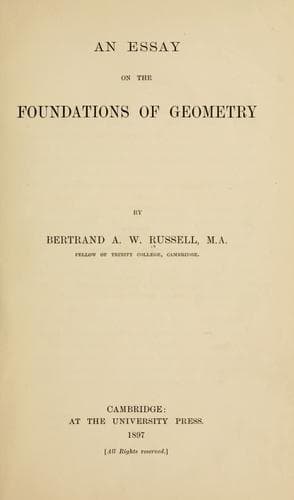
An essay on the foundations of geometryRussell, Bertrand
Philosophy
An essay on the foundations of geometry
Russell, Bertrand
Geometry -- Foundations
_Calinon_, in an interesting article on the geometrical
indeterminateness of the universe, maintains that any Geometry may be
applied to the actual world by a suitable hypothesis as to the course
of light-rays. For the earth only is known to us otherwise than by
Optics, and the earth is an infinitesimal part of the universe.
This line of argument has been already discussed in connection with
Lotze, but Calinon adds a new suggestion, that the space-constant may
perhaps vary with the time. This would involve a causal connection
between space and other things, which seems hardly conceivable, and
which, if regarded as possible, must surely destroy Geometry, since
Geometry depends throughout on the irrelevance of Causation[112].
Moreover, in all operations of measurement, some time is spent;
unless we knew that space was unchanging throughout the operation,
it is hard to see how our results could be trustworthy, and how,
consequently, a change in the parameter could be discovered. The
same difficulties would arise, in fact, as those which result from
supposing space not homogeneous.
_Poincaré_ maintains that the question, whether Euclid or
Metageometry should be accepted, is one of convenience and
convention, not of truth; axioms are definitions in disguise, and the
choice between definitions is arbitrary. This view has been discussed
in Chapter I., in connection with Cayley's theory of distance, on
which it depends.
_Lechalas_ is a philosophical disciple of Calinon. He is a
rationalist of the pre-Kantian type, but a believer in the validity
of Metageometry. He holds that Geometry can dispense with all purely
spatial postulates, and work with axioms of magnitude alone[113],
which, in his opinion, are purely analytic. The principle of
contradiction, to him, is the sole and only test of truth; we make
long chains of reasoning from our premisses to see if contradictions
will emerge. It might be objected that this view, though it saves
general Geometry from being logically empirical, leaves it only
empirically logical; this must, in fact, be the fate of every piece
of _à priori_ knowledge, if M. Lechalas's were the only test of
truth. However, he concludes that general Geometry is apodeictic,
while the space of our actual world, like all other phenomena, is
contingent.
_Delbœuf_ criticizes non-Euclidean space from an ultra-realist
standpoint: he holds that _real_ space is neither homogeneous nor
isogeneous, but that _conceived_ space, as abstracted from real
space, has both these properties. He offers no justification for
his real space, which seems to be maintained in the spirit of naïve
realism, nor does he show how he has acquired his intimate knowledge
of its constitution[114]. His arguments against Metageometry, in so
far as they are not repetitions of Lotze, have been discussed above.
Public-domain text, read in full here on John Shaqi.
Reviews
Reviews
No reviews yet
Be the first to share your thoughts on this work.
Elsewhere in the archive
Join the Discussion
Join the discussion
Sign in to leave a comment or review.
Sign InorCreate an account