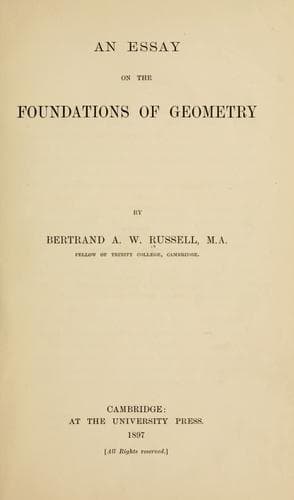
An essay on the foundations of geometryRussell, Bertrand
Philosophy
An essay on the foundations of geometry
Russell, Bertrand
Geometry -- Foundations
[101] See Lectures and Essays, Vol. I. p. 261.
[102] On the meaning of geometrical possibility, cf. Veronese,
Grundzüge der Geometrie (German translation), pp. xi.-xiii.
[103] Compare Calinon, "Sur l'Indétermination géométrique de
l'Univers," Revue Philosophique, 1893, Vol. XXXVI. pp. 595-607.
[104] Vorträge und Reden, Vol. II. p. 9: "Parallele Linien würden
die Bewohner der Kugel gar nicht kennen. Sie würden behaupten, dass
jede beliebige zwei _geradeste_ Linien, gehörig verlangert, sich
schliesslich nicht nur in einem, sondern in zwei Punkten schneiden
müssten." (The italics are mine.) The omission of _straight_ in such
phrases is a frequent laxity of mathematicians.
[105] It has been suggested to me that Lotze regards the meridians
as projected on to a plane, as in a map. If this be so, there is an
obviously illegitimate introduction of the third dimension.
[106] This is proved by Helmholtz's remark at the end of a detailed
attempt to make spherical and pseudo-spherical spaces imaginable
(l.c. p. 28): "Anders ist es mit den drei Dimensionen des Raumes. Da
alle unsere Mittel sinnlicher Anschauung sich nur auf einen Raum von
drei Dimensionen erstrecken, und die vierte Dimension nicht bloss
eine Abänderung von Vorhandenem, sondern etwas vollkommen Neues wäre,
so befinden wir uns schon wegen unserer körperlichen Organisation in
der absoluten Unmöglichkeit, uns eine Anschauungsweise einer vierten
Dimension vorzustellen."
[107] Cf. Grassmann, Ausdehnungslehre von 1844, 2nd Edition, p. xxiii.
[108] See especially Stallo, Concepts of Modern Physics,
International Science Series, Vol. XLII. Chaps. XIII. and
XIV.; Renouvier, "Philosophie de la règle et du compas," Année
Philosophique, II.; Delbœuf, "L'ancienne et les nouvelles
géométries," Revue Philosophique, Vols. XXXVI.-XXXIX.
[109] M. Delbœuf deserves credit for having based Euclid, already in
1860, in his "Prolégomènes Philosophiques de la Géométrie," on this
axiom--certainly a better basis, at first sight, than the axiom of
parallels.
[110] This meaning of homogeneity must not be confounded with the
sense in which I have used the word. In Delbœuf's sense, it means
that figures may be similar though of different sizes; in my sense it
means that figures may be similar though in different places. This
property of space is called by Delbœuf isogeneity.
[111] For a full proof of this proposition, see Chap. III.
[112] See Chap. III., especially § 133.
[113] For a criticism of this view, see the above discussions on
Riemann and Erdmann.
[114] Cf. Couturat, "De l'Infini Mathématique," Paris, Félix Alcan,
1896, p. 544.
[115] The following is a list of the most important recent French
philosophical writings on Geometry, so far as I am acquainted with
them.
Andrade: "Les bases expérimentales de la géométrie euclidienne";
Rev. Phil. 1890, II., and 1891, I.
Bonnel: "Les hypothèses dans la géométrie"; Gauthier-Villars,
1897.
Public-domain text, read in full here on John Shaqi.
Reviews
Reviews
No reviews yet
Be the first to share your thoughts on this work.
Elsewhere in the archive
Join the Discussion
Join the discussion
Sign in to leave a comment or review.
Sign InorCreate an account