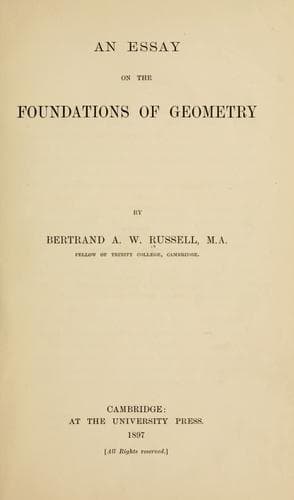
An essay on the foundations of geometryRussell, Bertrand
Philosophy
An essay on the foundations of geometry
Russell, Bertrand
Geometry -- Foundations
[83] The works of Helmholtz on geometrical philosophy comprise, in
addition to the articles quoted in Chap. I., the following articles:
"Ursprung und Sinn der geometrischen Axiome, gegen Land," Wiss. Abh.
Vol. II. p. 640, 1878. (Also Mind, Vol. III.: an answer to Land in
Mind, Vol. II.) "Ursprung und Bedeutung der geometrischen Axiome,"
1870, Vorträge und Reden, Vol. II. p. 1. (Also Mind, Vol. I.) Two
Appendices to "Die Thatsachen in der Wahrnehmung," entitled: II. "Der
Raum kann transcendental sein, ohne dass es die Axiome sind"; and
III. "Die Anwendbarkeit der Axiome auf die physische Welt," 1878,
Vorträge und Reden, Vol. II. p. 256 ff.
The two Appendices last mentioned are popularizings and expansions of
the article in Mind, Vol. III. The most widely read, though also, to
my mind, the least valuable, of all Helmholtz's writings on Geometry,
is the article in Mind, Vol. I. This contains the famous and much
misunderstood analogies of Flatland and Sphereland, which will be
discussed, and as far as possible defended, in answering Lotze's
attack on Metageometry--an attack based, apparently, almost entirely
on this one popular article. The present discussion, therefore, may
be confined almost entirely to Mind, Vol. III., and the philosophical
portions of the two papers quoted in Chap. I., _i.e._ to the articles
in Wiss. Abh. Vol. II. pp. 610-660. His other works are popular, and
important only because of the large public to which they appeal.
[84] In the answer to Land, Mind, Vol. III. and Wiss. Abh. II. p. 640.
[85] See also Die Thatsachen in der Wahrnehmung, Zusatz II., Der Raum
kann transcendental sein, ohne dass es die Axiome sind. Vorträge und
Reden, Vol. II.
[86] See below, criticism of Erdmann, § 84.
[87] See Prof. Land, in Mind, Vol. II.
[88] See concluding paragraph of Helmholtz's article in Mind, Vol.
III.
[89] Cf. Veronese, Grundzüge der Geometrie (German translation), p.
ix. Also pp. xxxiv, 304, and Note II. pp. 692-4.
[90] See Chap. IV. § 197 ff.
[91] Cf. the opinion of Bolyai, quoted by Erdmann, Axiome, p. 26; cf.
also ib. p. 60.
[92] Die Axiome der Geometrie: Eine philosophische Untersuchung der
Riemann-Helmholtz'schen Raumtheorie, Leipzig, 1877.
[93] On the influence of Mill, cf. Stallo, Concepts of Modern
Physics, p. 216.
[94] This view seems to be derived, through Riemann, from Herbart.
See Psych. als Wiss. ed. Hart. Vol. V. p. 262.
[95] The same irreducibility of space to mere magnitude is proved by
Kant's hands and spherical triangles, in which a difference persists
in spite of complete quantitative equality.
[96] See §§ 146-7.
[97] "Jeder Versuch, Kant's Lehre von der Apriorität als
des subjectiven, von aller Erfahrung absolut unabhängigen
Erkenntnissfactors, trotzdem zu halten, ist deshalb von voruherein
aussichtslos."
[98] Ausdehnungslehre von 1844, 2nd edition, pp. xxii. xxiii.
[99] See § 129 ff.
[100] Metaphysik, Book II. Chap. II. My references are to the
original.
Public-domain text, read in full here on John Shaqi.
Reviews
Reviews
No reviews yet
Be the first to share your thoughts on this work.
Elsewhere in the archive
Join the Discussion
Join the discussion
Sign in to leave a comment or review.
Sign InorCreate an account