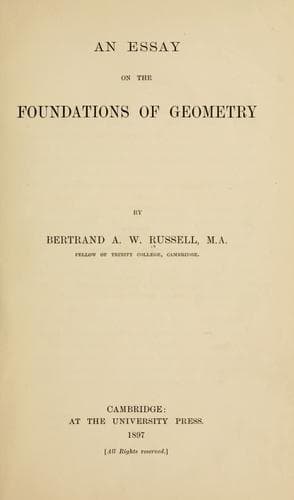
An essay on the foundations of geometryRussell, Bertrand
Philosophy
An essay on the foundations of geometry
Russell, Bertrand
Geometry -- Foundations
"_To cut by a fixed plane σ (transversal plane_) a figure (_αβγδ_ ...
_abcd_ ...) made up of planes and straight lines, is to construct the
straight lines or _traces σα, σβ, σγ_ ... and the points or _traces
σa, σb, σc_....[121] By this means we obtain a new figure
composed of straight lines and points lying in the plane _σ_.
"_To project from a fixed straight line s_ (the _axis_) a figure
_ABCD_ composed of points, is to construct the planes _sA_, _sB_,
_sC_.... The figure thus obtained is composed of planes which all
pass through the axis _s_.
"_To cut by a fixed straight line s_ (a _transversal_) a figure
_αβγδ_ ... composed of planes, is to construct the points _sα_, _sβ_,
_sγ_.... In this way a new figure is obtained, composed of points all
lying on the fixed transversal _s_.
"If a figure is composed of straight lines _a_, _b_, _c_ ... which
all pass through a fixed point or _centre S_, it can be _projected_
from a straight line or _axis s_ passing through _S_; the result is a
figure composed of planes _sa_, _sb_, _sc_....
"If a figure is composed of straight lines _a_, _b_, _c_ ...
all lying in a fixed plane, it may be cut by a straight line
(transversal) _s_ lying in the same plane; the figure which results
is formed by the points _sa_, _sb_, _sc_...."
=110.= The successive application, to any figure, of two reciprocal
operations of projection and section, is regarded as producing a
figure protectively indistinguishable from the first, provided only
that the dimensions of the original figure were the same as those
of the resulting figure, that, for example, if the second operation
be section by a plane, the original figure shall have been a plane
figure. The figures obtained from a given figure, by projection
or section alone, are related to that figure by the principle of
duality, of which we shall have to speak later on.
I shall endeavour to show, in what follows, first, in what sense
figures obtained from each other by projective transformation are
qualitatively alike; secondly, what axioms, or adjectives of space,
are involved in the principle of projective transformation; and
thirdly, that these adjectives must belong to any form of externality
with more than one dimension, and are, therefore, _à priori_
properties of any possible space.
For the sake of simplicity, I shall in general confine myself to two
dimensions. In so doing, I shall introduce no important difference of
principle, and shall greatly simplify the mathematics involved.
=111.= The two mathematically fundamental things in projective
Geometry are anharmonic ratio, and the quadrilateral construction.
Everything else follows mathematically from these two. Now what is
meant, in projective Geometry, by anharmonic ratio?
[Illustration]
Public-domain text, read in full here on John Shaqi.
Reviews
Reviews
No reviews yet
Be the first to share your thoughts on this work.
Elsewhere in the archive
Join the Discussion
Join the discussion
Sign in to leave a comment or review.
Sign InorCreate an account