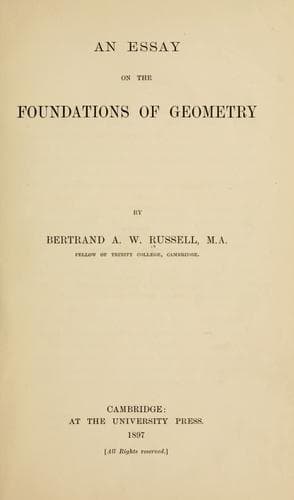
An essay on the foundations of geometryRussell, Bertrand
Philosophy
An essay on the foundations of geometry
Russell, Bertrand
Geometry -- Foundations
=108.= All geometrical reasoning is, in the last resort, circular:
if we start by assuming points, they can only be defined by the
lines or planes which relate them; and if we start by assuming lines
or planes, they can only be defined by the points through which
they pass. This is an inevitable circle, whose ground of necessity
will appear as we proceed. It is, therefore, somewhat arbitrary to
start either with points or with lines, as the eminently projective
principle of duality mathematically illustrates; nevertheless we will
elect, with most geometers, to start with points[120]. We suppose,
therefore, as our datum, a set of discrete points, for the moment
without regard to their interconnections. But since connections are
essential to any reasoning about them as a system, we introduce, to
begin with, the axiom of the straight line. Any two of our points,
we say, lie on a line which those two points completely define.
This line, being determined by the two points, may be regarded as
a relation of the two points, or an adjective of the system formed
by both together. This is the only purely qualitative adjective--as
will be proved later--of a system of two points. Now projective
Geometry can only take account of qualitative adjectives, and can
distinguish between different points only by their relations to
other points, since all points, _per se_, are qualitatively similar.
Hence it comes that, for projective Geometry, when two points only
are given, they are qualitatively indistinguishable from any two
other points on the same straight line, since any two such other
points have the same qualitative relation. Reciprocally, since one
straight line is a figure determined by any two of its points, and
all points are qualitatively similar, it follows that all straight
lines are qualitatively similar. We may regard a point, therefore, as
determined by two straight lines which meet in it, and the point,
on this view, becomes the only qualitative relation between the two
straight lines. Hence, if the point only be regarded as given, the
two straight lines are qualitatively indistinguishable from any other
pair through the point.
=109.= The extension of these two reciprocal principles is the
essence of all projective transformations, and indeed of all
projective Geometry. The fundamental operations, by which figures
are projectively transformed, are called projection and section. The
various forms of projection and section are defined in Cremona's
"Projective Geometry," Chapter I., from which I quote the following
account.
"_To project from a fixed point S_ (the _centre of projection_) a
figure (_ABCD_ ... _abcd_ ...) composed of points and straight lines,
is to construct the straight lines or _projecting rays SA_, _SB_,
_SC_, _SD_, ... and the planes (_projecting planes_) _Sa_, _Sb_,
_Sc_, _Sd_, ... We thus obtain a new figure composed of straight
lines and planes which all pass through the centre _S_.
Public-domain text, read in full here on John Shaqi.
Reviews
Reviews
No reviews yet
Be the first to share your thoughts on this work.
Elsewhere in the archive
Join the Discussion
Join the discussion
Sign in to leave a comment or review.
Sign InorCreate an account