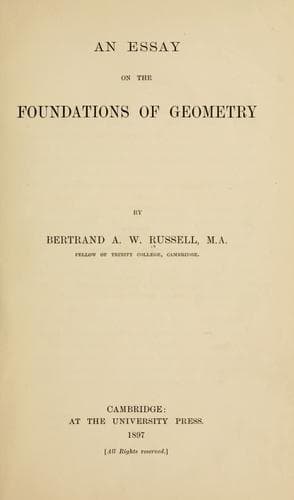
An essay on the foundations of geometryRussell, Bertrand
Philosophy
An essay on the foundations of geometry
Russell, Bertrand
Geometry -- Foundations
=116.= How are we to get outside this circle? The fact is that, in
pure Geometry, we cannot get outside it. For space, as we shall see
more fully hereafter, is nothing but relations; if, therefore, we
take any spatial figure, and seek for the terms between which it is a
relation, we are compelled, in Geometry, to seek these terms within
space, since we have nowhere else to seek them, but we are doomed,
since anything purely spatial is a mere relation, to find our terms
melting away as we grasp them.
Thus the relativity of space, while it is the essence of the
principle of duality, at the same time renders impossible the
expression of that principle, or of any other principle of pure
Geometry, in a manner which shall be free from contradictions.
Nevertheless, if we are to advance at all with our analysis of
geometrical reasoning and with our definitions of lines and points,
we must, for a while, ignore this contradiction; we must argue
as though it did not exist, so as to free our science from any
contradictions which are not inevitable.
=117.= In accordance with this procedure, then, let us define our
points as the terms of spatial relations, regarding whatever is not
a point as a relation between points. What, on this view, must our
points be taken to be? Obviously, if extension is mere relativity,
they must be taken to contain no extension; but if they are to
supply the terms for spatial relations, _e.g._ for straight lines,
these relations must exhibit them as the terms of the figures they
relate. In other words, since what can really be taken, without
contradiction, as the term of a spatial relation, is unextended, we
must take, as the term to be used in Geometry, where we cannot go
outside space, the least spatial thing which Geometry can deal with,
the thing which, though _in_ space, _contains_ no space; and this
thing we define as the point[127].
Neglecting, then, the fundamental contradiction in this definition,
the rest of our definitions follow without difficulty. The straight
line is the relation between two points, and the plane is the
relation between three. These definitions will be argued and defended
at length in section B of this Chapter[128], where we can discuss at
the same time the alternative metrical definitions; for our present
purpose, it is sufficient to observe that projective Geometry, from
the first, regards the straight line as determined by two points, and
the plane as determined by three, from which it follows, if we take
points as possible terms for spatial relations, that the straight
line and the plane may be regarded as relations between two and three
points respectively. If we agree on these definitions, we can proceed
to discuss the fundamental principle of projective Geometry, and to
analyse the axioms implicated in its truth.
Public-domain text, read in full here on John Shaqi.
Reviews
Reviews
No reviews yet
Be the first to share your thoughts on this work.
Elsewhere in the archive
Join the Discussion
Join the discussion
Sign in to leave a comment or review.
Sign InorCreate an account