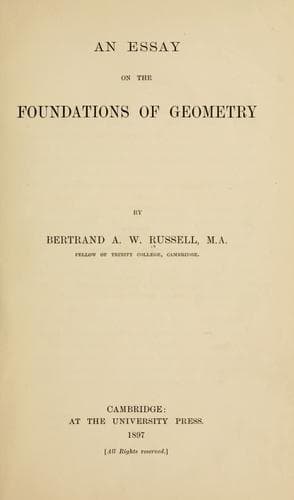
An essay on the foundations of geometryRussell, Bertrand
Philosophy
An essay on the foundations of geometry
Russell, Bertrand
Geometry -- Foundations
=118.= Projective Geometry, we have seen, does not deal with
quantity, and therefore recognizes no difference where the
difference is purely quantitative. Now quantitative comparison
depends on a recognized identity of quality; the recognition of
qualitative identity, therefore, is logically prior to quantity, and
presupposed by every judgment of quantity. Hence all figures, whose
differences can be exhaustively described by quantity, _i.e._ by
pure measurement, must have an identity of quality, and this must be
recognizable without appeal to quantity. It follows that, by defining
the word quality in geometrical matters, we shall discover what
sets of figures are projectively indiscernible. If our definition
is correct, it ought to yield the general projective principle with
which we set out.
=119.= We agreed to regard points as the terms of spatial relations,
and we agreed that different points could be distinguished. But
we postponed the discussion of the conditions under which this
distinction could be effected. This discussion will yield us the
definition of quality and the proof of our general projective
principle.
Points, to begin with, have been defined as nothing but the terms for
spatial relations. They have, therefore, no intrinsic properties;
but are distinguished solely by means of their relations. Now the
relation between two points, we said, is the straight line on which
they lie. This gives that identity of quality for all pairs of points
on the same straight line, which is required both by our projective
principle and by metrical Geometry. (For only where there is identity
of quality can quantity be properly applied.) If only two points are
given, they cannot, without the use of quantity, be distinguished
from any two other points on the same straight line; for the
qualitative relation between any two such points is the same as for
the original pair, and only by a difference of relation can points be
distinguished from one another.
But conversely, one straight line is nothing but the relation
between two of its points, and all points are qualitatively alike.
Hence there can be nothing to distinguish one straight line from
another except the points through which it passes, and these are
distinguished from other points only by the fact that it passes
through them. Thus we get the reciprocal transformation: if we are
given only one point, any pair of straight lines through that point
is qualitatively indistinguishable from any other. This again is, on
the one hand, the basis of the second part of our general projective
principle, and on the other hand the condition of applying quantity,
in the measurement of angles, to the departure of two intersecting
straight lines.
Public-domain text, read in full here on John Shaqi.
Reviews
Reviews
No reviews yet
Be the first to share your thoughts on this work.
Elsewhere in the archive
Join the Discussion
Join the discussion
Sign in to leave a comment or review.
Sign InorCreate an account