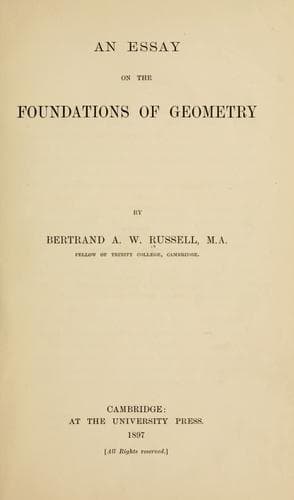
An essay on the foundations of geometryRussell, Bertrand
Philosophy
An essay on the foundations of geometry
Russell, Bertrand
Geometry -- Foundations
=129.= In the first place, externality is an essentially relative
conception--nothing can be external to itself. To be external to
something is to be another with some relation to that thing. Hence,
when we abstract a form of externality from all material content,
and study it in isolation, position will appear, of necessity,
as purely relative--a position can have no intrinsic quality, for
our form consists of pure externality, and externality contains
no shadow or trace of an intrinsic quality. Thus we obtain our
fundamental postulate, the relativity of position, or, as we may put
it, the complete absence, on the part of our form, of any vestige of
thinghood.
The same argument may also be stated as follows: If we abstract the
conception of externality, and endeavour to deal with it _per se_, it
is evident that we must obtain an object alike destitute of elements
and of totality. For we have abstracted from the diverse matter
which filled our form, while any element, or any whole, would retain
some of the qualities of a matter. Either an element or a whole, in
fact, would have to be a thing not external to itself, and would
thus contain something not pure externality. Hence arise infinite
divisibility, with the self-contradictory notion of the point, in the
search for elements, and unbounded extension, with the contradiction
of an infinite regress or a vicious circle, in the search for a
completed whole. Thus again, our form contains neither elements nor
totality, but only endless relations--the terms of these relations
being excluded by our abstraction from the matter which fills our
form.
=130.= In like manner we can deduce the homogeneity of our form. The
diversity of content, which was possible only within the form of
externality, has been abstracted from, leaving nothing but the bare
possibility of diversity, the bare principle of differentiation,
itself uniform and undifferentiated. For if diversity presupposes
such a form, the form cannot, unless it were contained in a fresh
form, be itself diverse or differentiated.
Or we may deduce the same property from the relativity of position.
For any quality in one position, by which it was marked out from
another, would be necessarily more or less intrinsic, and would
contradict the pure relativity. Hence all positions are qualitatively
alike, _i.e._ the form is homogeneous throughout.
Public-domain text, read in full here on John Shaqi.
Reviews
Reviews
No reviews yet
Be the first to share your thoughts on this work.
Elsewhere in the archive
Join the Discussion
Join the discussion
Sign in to leave a comment or review.
Sign InorCreate an account