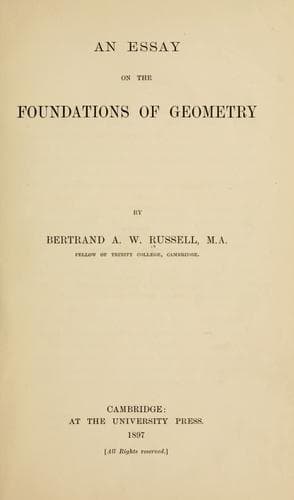
An essay on the foundations of geometryRussell, Bertrand
Philosophy
An essay on the foundations of geometry
Russell, Bertrand
Geometry -- Foundations
=127.= The pure doctrine of extension, as constructed by Grassmann,
need not be discussed--it included much empirical material, and was
philosophically a failure. But his principles, I think, will enable
us to prove that projective Geometry, abstractly interpreted, is
the science which he foresaw, and deals with a matter which can be
constructed by the pure intellect alone. If this be so, however,
it must be observed that projective Geometry, for the moment, is
rendered purely hypothetical[132]. All necessary truth, as Bradley
has shown, is hypothetical[133], and asserts, _primâ facie_, only
the ground on which rests the necessary connection of premisses
and conclusion. If we construct a mere conception of externality,
and thus abandon our actually given space, the result of our
construction, until we return to something actually given, remains
without existential import--if there _be_ experienced externality, it
asserts, then there must be a form of externality with such and such
properties. That there must be experienced externality, Kant's first
argument about space proves, I think, to those who admit experience
of a world of diverse but interrelated things. But this is a question
which belongs to the next Chapter.
What we have to do here is, not to discuss whether there is a form of
externality, but whether, if there be such a form, it must possess
the properties embodied in the axioms of projective Geometry. Now
first of all, what do we mean by such a form?
=128.= In any world in which perception presents us with various
things, with discriminated and differentiated contents, there must
be, in perception, at least one "principle of differentiation[134],"
an element, that is, by which the things presented are distinguished
as various. This element, taken in isolation, and abstracted from the
content which it differentiates, we may call a form of externality.
That it must, when taken in isolation, appear as a form, and not as
a mere diversity of material content, is, I think, fairly obvious.
For a diversity of material content cannot be studied apart from
that material content; what we wish to study here, on the contrary,
is the bare possibility of such diversity, which forms the residuum,
as I shall try to prove hereafter[135], when we abstract from any
sense-perception all that is distinctive of its particular matter.
This possibility, then, this principle of bare diversity, is our form
of externality. How far it is necessary to assume such a form, as
distinct from interrelated things, I shall consider later on[136].
For the present, since space, as dealt with by Geometry, is certainly
a form of this kind, we have only to ask: What properties must such a
form, when studied in abstraction, necessarily possess?
Public-domain text, read in full here on John Shaqi.
Reviews
Reviews
No reviews yet
Be the first to share your thoughts on this work.
Elsewhere in the archive
Join the Discussion
Join the discussion
Sign in to leave a comment or review.
Sign InorCreate an account