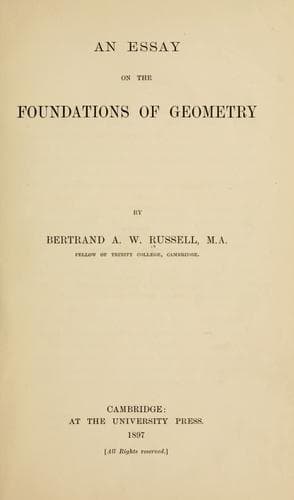
An essay on the foundations of geometryRussell, Bertrand
Philosophy
An essay on the foundations of geometry
Russell, Bertrand
Geometry -- Foundations
=135.= Before proceeding further, it is necessary to discuss the
important special case where a form of externality has only one
dimension. Of the two such forms, given in experience, one, namely
time, presents an instance of this special case. But it may be shown,
I think, that the function, in constituting the possibility of
experience, which we demand of such forms, could not be accomplished
by a one-dimensional form alone. For in a one-dimensional form, the
various contents may be arranged in a series, and cannot, without
interpenetration, change the order of contents in the series.
But interpenetration is impossible, since a form of externality
is the mere expression of diversity among things, from which it
follows that things cannot occupy the same position in a form,
unless there is another form by which to differentiate them. For
without externality, there is no diversity[142]. Thus two bodies
may occupy the same space, but only at different times: two things
may exist simultaneously, but only at different places. A form of
one dimension, therefore, could not, by itself, allow that change
of the relations of externality, by which alone a varied world
of interrelated things can be brought into consciousness. In a
one-dimensional space, for example, only a single object, which must
appear as a point, or two objects at most, one in front and one
behind, could ever be perceived. Thus two or more dimensions seem
an essential condition of anything worth calling an experience of
interrelated things.
=136.= It may be objected, to this argument, that its validity
depends upon the assumption that the change of a relation of
externality must be continuous. Both to make and to meet this
objection, in a manner which shall not imply time, seems almost
impossible. For we cannot speak of change, whether continuous or
discrete, without imagining time. Let us, therefore, allow time to
be known, and discuss whether the temporal change, in any other form
of externality, is necessarily continuous[143]. We must reply, I
think, that continuity is necessary. The change of relation, in our
non-temporal form, may be safely described as motion, and the law
of Causality--since we have already assumed time--may be applied to
this motion. It then follows that discrete motion would involve a
finite effect from an infinitesimal cause, for a cause acting only
for a moment of time would be infinitesimal. It involves, also, a
validity in the point of time, whereas what is valid in any form of
externality is not, as we have already seen, the infinitesimal and
self-contradictory element resulting from infinite division, but the
finite relation which mathematics analyzes into vanishing elements.
Hence change must be continuous, and the possibility of serial
arrangement holds good.
Public-domain text, read in full here on John Shaqi.
Reviews
Reviews
No reviews yet
Be the first to share your thoughts on this work.
Elsewhere in the archive
Join the Discussion
Join the discussion
Sign in to leave a comment or review.
Sign InorCreate an account