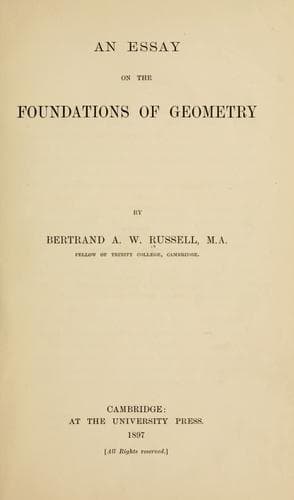
An essay on the foundations of geometryRussell, Bertrand
Philosophy
An essay on the foundations of geometry
Russell, Bertrand
Geometry -- Foundations
In a one-dimensional form other than time, the same argument must
hold. For something analogous to Causality would be necessary to
experience, and the relativity of the form would still necessarily
hold. Hence, since only these two properties of time have been
assumed, the above contention would remain valid of any second form
whose relations were correlated with those of the first, as the
analogue of Causality would require them to be.
=137.= The next step in the argument, which assumes two or more
dimensions, is concerned with the general analogues of straight
lines and planes, _i.e._ with figures--which may be regarded either
as relations between positions or as series of positions--uniquely
determined by two or by three positions. If this step can be
successfully taken, our deduction of the above projective axioms will
be complete, and descriptive Geometry will be established as the
abstract _à priori_ doctrine of forms of externality.
To prove this contention, consider of what nature the relations
can be by which positions are defined. We have seen already that
our form is purely relational and infinitely divisible, and that
positions (points) are the self-contradictory outcome of the search
for something other than relations. What we really mean, therefore,
by the relations defining a position, is, when we undo our previous
abstraction, the relations of externality by which some thing is
related to other things. But how, when we remain in the abstract
form, must such relations appear?
Public-domain text, read in full here on John Shaqi.
Reviews
Reviews
No reviews yet
Be the first to share your thoughts on this work.
Elsewhere in the archive
Join the Discussion
Join the discussion
Sign in to leave a comment or review.
Sign InorCreate an account