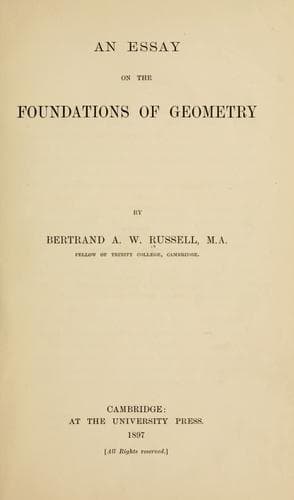
An essay on the foundations of geometryRussell, Bertrand
Philosophy
An essay on the foundations of geometry
Russell, Bertrand
Geometry -- Foundations
=144.= We require, then, at the very outset, some criterion of
spatial equality: without such a criterion metrical Geometry would
become wholly impossible. It might appear, at first sight, as though
this need not be an axiom, but might be a mere definition. In part
this is true, but not wholly. The part which is merely a definition
is given in Euclid's eighth axiom: "Magnitudes which exactly coincide
are equal." But this gives a sufficient criterion only when the
magnitudes to be compared already occupy the same position. When, as
will normally be the case, the two spatial magnitudes are external to
one another--as, indeed, must be the case, if they are distinct, and
not whole and part--the two magnitudes can only be made to coincide
by a motion of one or both of them. In order, therefore, that our
definition of spatial magnitude may give unambiguous results,
coincidence when superposed, if it can ever occur, must occur always,
whatever path be pursued in bringing it about. Hence, if mere motion
could alter shapes, our criterion of equality would break down.
It follows that the application of the conception of magnitude
to figures in space involves the following axiom[150]: _Spatial
magnitudes can be moved from place to place without distortion_; or,
as it may be put, _Shapes do not in any way depend upon absolute
position in space_.
The above axiom is the axiom of Free Mobility[151]. I propose to
prove (1) that the denial of this axiom would involve logical and
philosophical absurdities, so that it must be classed as wholly _à
priori_; (2) that metrical Geometry, if it refused this axiom, would
be unable, without a logical absurdity, to establish the notion of
spatial magnitude at all. The conclusion will be, that the axiom
cannot be proved or disproved by experience, but is an _à priori_
condition of metrical Geometry. As I shall thus be maintaining a
position which has been much controverted, especially by Helmholtz
and Erdmann, I shall have to enter into the arguments at some length.
Public-domain text, read in full here on John Shaqi.
Reviews
Reviews
No reviews yet
Be the first to share your thoughts on this work.
Elsewhere in the archive
Join the Discussion
Join the discussion
Sign in to leave a comment or review.
Sign InorCreate an account