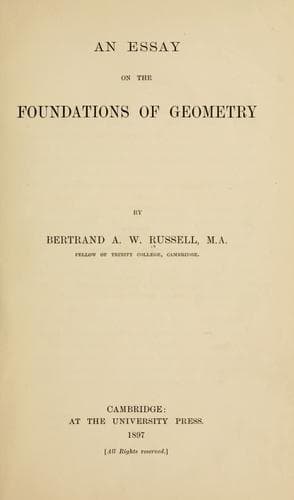
An essay on the foundations of geometryRussell, Bertrand
Philosophy
An essay on the foundations of geometry
Russell, Bertrand
Geometry -- Foundations
Let us now examine in detail the prerequisites of spatial
measurement. We shall find three axioms, without which such
measurement would be impossible, but with which it is adequate to
decide, empirically and approximately, the Euclidean or non-Euclidean
nature of our actual space. We shall find, further, that these three
axioms can be deduced from the conception of a form of externality,
and owe nothing to the evidence of intuition. They are, therefore,
like their equivalents the axioms of projective Geometry, _à priori_,
and deducible from the conditions of spatial experience. This
experience, accordingly, can never disprove them, since its very
existence presupposes them.
I. _The Axiom of Free Mobility._
=143.= Metrical Geometry, to begin with, may be defined as the
science which deals with the comparison and relations of spatial
magnitudes. The conception of magnitude, therefore, is necessary from
the start. Some of Euclid's axioms, accordingly, have been classed as
arithmetical, and have been supposed to have nothing particular to do
with space. Such are the axioms that equals added to or subtracted
from equals give equals, and that things which are equal to the same
thing are equal to one another. These axioms, it is said, are purely
arithmetical, and do not, like the others, ascribe an adjective to
space. As regards their use in arithmetic, this is of course true.
But if an arithmetical axiom is to be applied to spatial magnitudes,
it must have some spatial import[147], and thus even this class is
not, in Geometry, _merely_ arithmetical. Fortunately, the geometrical
element is the same in all the axioms of this class--we can see at
once, in fact, that it can amount to no more than a definition of
spatial magnitude[148]. Again, since the space with which Geometry
deals is infinitely divisible, a definition of spatial magnitude
reduces itself to a definition of spatial equality, for, as soon as
we have this last, we can compare two spatial magnitudes by dividing
each into a number of equal units, and counting the number of such
units in each[149]. The ratio of the number of units is, of course,
the ratio of the two magnitudes.
Public-domain text, read in full here on John Shaqi.
Reviews
Reviews
No reviews yet
Be the first to share your thoughts on this work.
Elsewhere in the archive
Join the Discussion
Join the discussion
Sign in to leave a comment or review.
Sign InorCreate an account