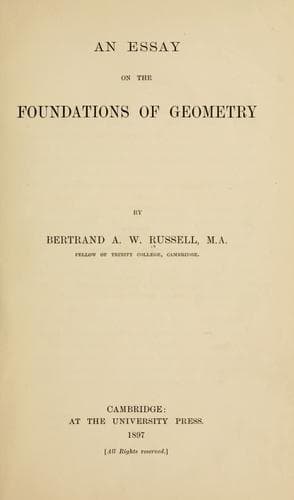
An essay on the foundations of geometryRussell, Bertrand
Philosophy
An essay on the foundations of geometry
Russell, Bertrand
Geometry -- Foundations
=146.= B. _Geometrical Argument._ Let us see next what sort of
Geometry we could construct without this axiom. The ultimate standard
of comparison of spatial magnitudes must, as we saw in introducing
the axiom, be equality when superposed; but need we, from this
equality, infer equality when separated? It has been urged by Erdmann
that, for the more immediate purposes of Geometry, this would be
unnecessary[153]. We might construct a new Geometry, he thinks, in
which sizes varied with motion on any definite law. Such a view,
as I shall show below, involves a logical error as to the nature
of magnitude. But before pointing this out, let us discuss the
geometrical consequences of assuming its truth. Suppose the length
of an infinitesimal arc in some standard position were _ds_; then
in any other position _p_ its length would be _ds.f(p)_, where the
form of the function _f(p)_ must be supposed known. But how are we
to determine the position _p_? For this purpose, we require _p_'s
coordinates, _i.e._, some measurement of distance from the origin.
But the distance from the origin could only be measured if we assumed
our law _f(p)_ to measure it by. For suppose the origin to be _O_,
and _Op_ to be a straight line whose length is required. If we have
a measuring rod with which we travel along the line and measure
successive infinitesimal arcs, the measuring rod will change its
size as we move, so that an arc which appears by the measure to be
_ds_ will really be _f(s).ds_, where _s_ is the previously traversed
distance. If, on the other hand, we move our line _Op_ slowly through
the origin, and measure each piece as it passes through, our measure,
it is true, will not alter, but now we have no means of discovering
the law by which any element has changed its length in coming to
the origin. Hence, until we assume our function _f(p)_, we have no
means of determining _p_, for we have just seen that distances from
the origin can only be estimated by means of the law _f(p)_. It
follows that experience can neither prove nor disprove the constancy
of shapes throughout motion, since, if shapes were not constant, we
should have to _assume_ a law of their variation before measurement
became possible, and therefore measurement could not itself reveal
that variation to us[154].
Public-domain text, read in full here on John Shaqi.
Reviews
Reviews
No reviews yet
Be the first to share your thoughts on this work.
Elsewhere in the archive
Join the Discussion
Join the discussion
Sign in to leave a comment or review.
Sign InorCreate an account