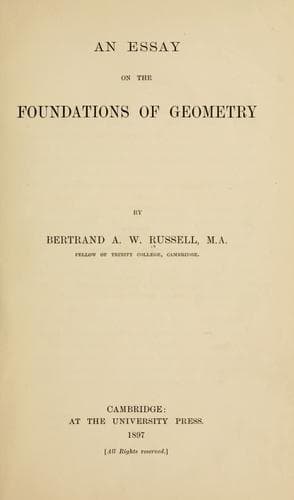
An essay on the foundations of geometryRussell, Bertrand
Philosophy
An essay on the foundations of geometry
Russell, Bertrand
Geometry -- Foundations
Nevertheless, such an arbitrarily assumed law _does_, at first sight,
give a mathematically possible Geometry. The fundamental proposition,
that two magnitudes which can be superposed in any one position can
be superposed in any other, still holds. For two infinitesimal arcs,
whose lengths in the standard position are _ds{1}_ and _ds{2}_,
would, in any other position _p_, have lengths _f(p).ds{1}_ and
_f(p).ds{2}_, so that their ratio would be unaltered. From this
constancy of ratio, as we know through Riemann and Helmholtz, the
above proposition follows. Hence all that Geometry requires, it would
seem, as a basis for measurement, is an axiom that the alteration
of shapes during motion follows a definite known law, such as that
assumed above.
=147.= There is, however, in such a view, as I remarked above, a
logical error as to the nature of magnitude. This error has been
already pointed out in dealing with Erdmann[155], and need only be
briefly repeated here. A judgment of magnitude is essentially a
judgment of comparison: in unmeasured quantity, comparison as to
the mere more or less, but in measured magnitude, comparison as to
the precise how many times. To speak of differences of magnitude,
therefore, in a case where comparison cannot reveal them, is
logically absurd. Now in the case contemplated above, two magnitudes,
which appear equal in one position, appear equal also when compared
in another position. There is no sense, therefore, in supposing
the two magnitudes unequal when separated, nor in supposing,
consequently, that they have changed their magnitudes in motion.
This senselessness of our hypothesis is the logical ground of the
mathematical indeterminateness as to the law of variation. Since,
then, there is no means of comparing two spatial figures, as regards
magnitude, except superposition, the only logically possible axiom,
if spatial magnitude is to be self-consistent, is the axiom of Free
Mobility in the form first given above.
=148.= Although this axiom is _à priori_, its application to the
measurement of actual bodies, as we found in discussing Helmholtz's
views, always involves an empirical element[156]. Our axiom, then,
only supplies the _à priori_ condition for carrying out an operation
which, in the concrete, is empirical--just as arithmetic supplies the
_à priori_ condition for a census. As this topic has been discussed
at length in Chapter II., I shall say no more about it here.
Public-domain text, read in full here on John Shaqi.
Reviews
Reviews
No reviews yet
Be the first to share your thoughts on this work.
Elsewhere in the archive
Join the Discussion
Join the discussion
Sign in to leave a comment or review.
Sign InorCreate an account