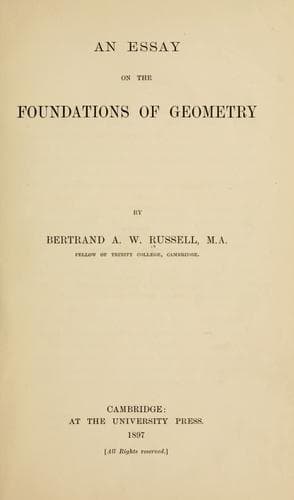
An essay on the foundations of geometryRussell, Bertrand
Philosophy
An essay on the foundations of geometry
Russell, Bertrand
Geometry -- Foundations
this one case of equality of volumes, the rest of the theory follows;
as appears from the ordinary method of integrating volumes, by
dividing them into small cubes.
Thus congruence _helps_ to establish three-dimensional equality,
though it cannot directly _prove_ such equality; and the same
philosophical principle, of the homogeneity of space, by which
congruence was proved, comes to our rescue here. But how about
right-handed and left-handed screws? Here we can no longer apply the
Identity of Indiscernibles, for the two are very well discernible.
But as with solids, so here, Free Mobility can help us much. It
can enable us, by ordinary measurement, to show that the internal
relations of both screws are the same, and that the difference lies
only in their relation to other things in space. Knowing these
internal relations, we can calculate, by the Geometry which Free
Mobility has rendered possible, all the geometrical properties of
these screws--radius, pitch, etc.--and can show them to be severally
equal in both. But this is all we require. Mediate comparison is
possible, though immediate comparison is not. Both can, for instance,
be compared with the cylinder on which both would fit, and thus their
equality can be proved. A precisely similar proof holds, of course,
for the other cases, right and left hands, spherical triangles, etc.
On the whole, these cases confirm my argument; for they show, as Kant
intended them to show[158], the essential relativity of space.
=151.= (2) As regards time, no congruence is here conceivable,
for to effect congruence requires always--as we saw in the case
of solids--one more dimension than belongs to the magnitudes
compared. No day can be brought into temporal coincidence with any
other day, to show that the two exactly cover each other; we are
therefore reduced to the arbitrary assumption that some motion or
set of motions, given us in experience, is uniform. Fortunately,
we have a large set of motions which all roughly agree; the swing
of the pendulum, the rotation and revolution of the earth and the
planets, etc. These do not exactly agree, but they lead us to the
laws of motion, by which we are able, on our arbitrary hypothesis,
to estimate their small departures from uniformity; just as the
assumption of Free Mobility enabled us to measure the departures
of actual bodies from rigidity. But here, as there, another
possibility is mathematically open to us, and can only be excluded
by its philosophic absurdity; we might have assumed that the above
set of approximately agreeing motions all had velocities which
varied approximately as some arbitrarily assumed function of the
time, _f(t)_ say, measured from some arbitrary origin. Such an
assumption would still keep them as nearly synchronous as before,
and would give an equally possible, though more complex, system
of Mechanics; instead of the first law of motion, we should have
the following: A particle perseveres in its state of rest, or of
Public-domain text, read in full here on John Shaqi.
Reviews
Reviews
No reviews yet
Be the first to share your thoughts on this work.
Elsewhere in the archive
Join the Discussion
Join the discussion
Sign in to leave a comment or review.
Sign InorCreate an account