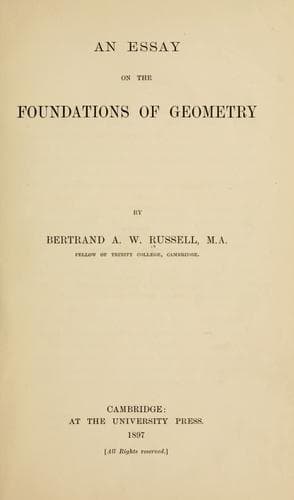
An essay on the foundations of geometryRussell, Bertrand
Philosophy
An essay on the foundations of geometry
Russell, Bertrand
Geometry -- Foundations
rectilinear motion with velocity varying as _f(t)_, except in so far
as it is compelled to alter that state by the action of external
forces. Such a hypothesis _is_ mathematically possible, but, like the
similar one for space, it is excluded logically by the comparative
nature of the judgment of quantity, and philosophically by the fact
that it involves absolute time, as a determining agent in change,
whereas time can never, philosophically, be anything but a passive
form, abstracted from change. I have introduced this parallel from
time, not as directly bearing on the argument, but as a simpler case
which may serve to illustrate my reasoning in the more complex case
of space. For since time, in mathematics, is one-dimensional, the
mathematical difficulties are simpler than in Geometry; and although
nothing accurately corresponds to congruence, there is a very similar
mixture of mathematical and philosophical necessity, giving, finally,
a thoroughly definite axiom as the basis of time-measurement,
corresponding to congruence as the basis of space-measurement[159].
=152.= (3) The case of time-measurement suggests the third of the
above objections to the absolute necessity of the axiom of Free
Mobility. Psycho-physics has shown that we have an approximate
power, by means of what may be called the sense of duration, of
immediately estimating equal short times. This establishes a rough
measure independent of any assumed uniform motion, and in space also,
it may be said, we have a similar power of immediate comparison.
We can see, by immediate inspection, that the sub-divisions on
a foot rule are not grossly inaccurate; and so, it may be said,
we both have a measure independent of congruence, and also could
discover, by experience, any gross departure from Free Mobility.
Against this view, however, there is at the outset a very fundamental
psychological objection. It has been urged that all our comparison
of spatial magnitudes proceeds by ideal superposition. Thus James
says (Psychology, Vol. II. p. 152): "Even where we only feel one
sub-division to be vaguely larger or less, the mind must pass rapidly
between it and the other sub-division, and receive the immediate
sensible shock of the more," and "so far as the sub-divisions of
a sense-space are to be _measured_ exactly against each other,
objective forms occupying one sub-division must be directly or
indirectly superposed upon the other[160]."
Public-domain text, read in full here on John Shaqi.
Reviews
Reviews
No reviews yet
Be the first to share your thoughts on this work.
Elsewhere in the archive
Join the Discussion
Join the discussion
Sign in to leave a comment or review.
Sign InorCreate an account