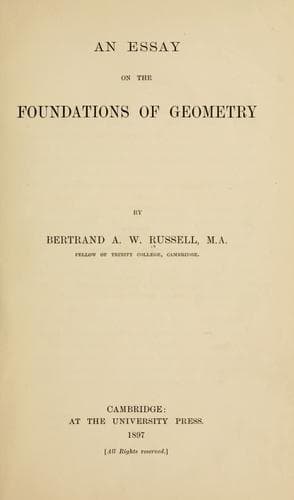
An essay on the foundations of geometryRussell, Bertrand
Philosophy
An essay on the foundations of geometry
Russell, Bertrand
Geometry -- Foundations
Even if we waive this fundamental objection, however, others remain.
To begin with, such judgments of equality are only very rough
approximations, and cannot be applied to lines of more than a certain
length, if only for the reason that such lines cannot well be seen
together. Thus this method can only give us any security in our own
immediate neighbourhood, and could in no wise warrant such operations
as would be required for the construction of maps &c., much less the
measurement of astronomical distances. They might just enable us to
say that some lines were longer than others, but they would leave
Geometry in a position no better than that of the Hedonical Calculus,
in which we depend on a purely subjective measure. So inaccurate, in
fact, is such a method acknowledged to be, that the foot-rule is as
much a need of daily life as of science. Besides, no one would trust
such immediate judgments, but for the fact that the stricter test of
congruence to some extent confirms them; if we could not apply this
test, we should have no ground for trusting them even as much as
we do. Thus we should have, here, no real escape from our absolute
dependence upon the axiom of Free Mobility.
=153.= (4) One last elucidatory remark is necessary before our proof
of this axiom can be considered complete. We spoke above of the
Geometry on an egg, where Free Mobility does not hold. What, I may
be asked, is there about a thoroughly non-congruent Geometry, more
impossible than this Geometry on the egg? The answer is obvious. The
Geometry of non-congruent surfaces is _only_ possible by the use of
infinitesimals, and in the infinitesimal all surfaces become plane.
The fundamental formula, that for the length of an infinitesimal
arc, is only obtained on the assumption that such an arc may be
treated as a straight line, and that Euclidean Plane Geometry may be
applied in the immediate neighbourhood of any point. If we had not
our Euclidean measure, which could be moved without distortion, we
should have no method of comparing small arcs in different places,
and the Geometry of non-congruent surfaces would break down. Thus
the axiom of Free Mobility, as regards three-dimensional space, is
necessarily implied and presupposed in the Geometry of non-congruent
surfaces; the possibility of the latter, therefore, is a dependent
and derivative possibility, and can form no argument against the _à
priori_ necessity of congruence as the test of equality.
Public-domain text, read in full here on John Shaqi.
Reviews
Reviews
No reviews yet
Be the first to share your thoughts on this work.
Elsewhere in the archive
Join the Discussion
Join the discussion
Sign in to leave a comment or review.
Sign InorCreate an account