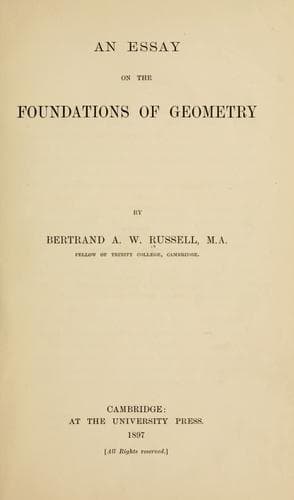
An essay on the foundations of geometryRussell, Bertrand
Philosophy
An essay on the foundations of geometry
Russell, Bertrand
Geometry -- Foundations
=158.= We have seen, in discussing the axiom of Free Mobility, that
all position is relative, that is, a position exists only by virtue
of relations[164]. It follows that, if positions can be defined at
all, they must be uniquely and exhaustively defined by some finite
number of such relations. If Geometry is to be possible, it must
happen that, after enough relations have been given to determine a
point uniquely, its relations to any fresh known point are deducible
from the relations already given. Hence we obtain, as an _à priori_
condition of Geometry, logically indispensable to its existence, the
axiom that _Space must have a finite integral number of Dimensions_.
For every relation required in the definition of a point constitutes
a dimension, and a fraction of a relation is meaningless. The number
of relations required must be finite, since an infinite number of
dimensions would be practically impossible to determine. If we
remember our axiom of Free Mobility, and remember also that space
is a continuum, we may state our axiom, for metrical Geometry, in
the form given by Helmholtz (v. Chap. I. § 25): "In a space of n
dimensions, the position of every point is uniquely determined by the
measurement of n continuous independent variables (coordinates).[165]"
=159.= So much, then, is _à priori_ necessary to metrical Geometry.
The restriction of the dimensions to three seems, on the contrary,
to be wholly the work of experience[166]. This restriction cannot
be logically necessary, for as soon as we have formulated any
analytical system, it appears wholly arbitrary. Why, we are driven
to ask, cannot we add a fourth coordinate to our _x_, _y_, _z_, or
give a geometrical meaning to _x^{4}_? In this more special form, we
are tempted to regard the axiom of dimensions, like the number of
inhabitants of a town, as a purely statistical fact, with no greater
necessity than such facts have.
Geometry affords intrinsic evidence of the truth of my division of
the axiom of dimensions into an _à priori_ and empirical portion.
For while the extension of the number of dimensions to four, or to
_n_, alters nothing in plane and solid Geometry, but only adds a
new branch which interferes in no way with the old, _some_ definite
number of dimensions is assumed in all Geometries, nor is it
possible to conceive of a Geometry which should be free from this
assumption[167].
Public-domain text, read in full here on John Shaqi.
Reviews
Reviews
No reviews yet
Be the first to share your thoughts on this work.
Elsewhere in the archive
Join the Discussion
Join the discussion
Sign in to leave a comment or review.
Sign InorCreate an account